AI estimate as of October 17, 2025 · verify with a professional before acting
AI-Generated · Verify before acting
Everything on this page is generated by AI for informational purposes only. AI can make mistakes — the AI may misidentify items or misattribute them (artist, maker, brand, designer, origin, era). This is not an official valuation and should not be used for insurance, sale, tax, estate, legal, or lending purposes — or any decision requiring a certified appraisal. It is not an authoritative claim about any person, brand, or rights holder — do not share or rely on it as a factual statement about a third party. Always consult qualified professionals before making financial decisions.
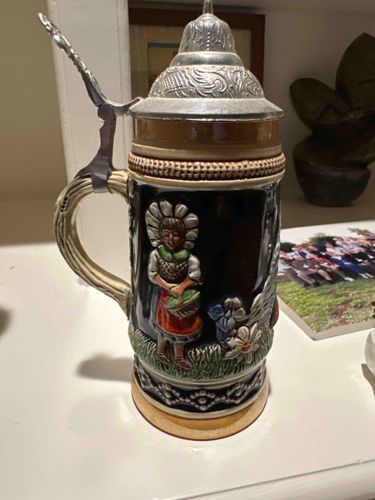
This is a ceramic beer stein, possibly German in origin, characterized by its traditional design and materials. The body of the stein is made of glazed ceramic, predominantly dark blue or black with raised, hand-painted relief decorations. The main motif depicts a woman in traditional attire, possibly a milkmaid or villager, holding a basket, standing in a field with flowers. There are other relief elements, such as trees or additional figures, partially visible on the sides. The colors visible in the relief are vibrant: green for grass and clothing, red for the skirt, and white/yellow for flowers and the woman's headwear. Above the decorated body, there is a lighter brown, unglazed or matte ceramic band, which transitions to a textured, woven-like band encircling the top rim of the ceramic body. The handle is an integral part of the ceramic body, featuring a textured, branch-like or braided design in a lighter, natural ceramic color.
The stein is topped with a hinged pewter lid, which is ornately decorated with embossed scrollwork and floral patterns. The lid has a domed shape, culminating in a small finial. A thumb lever, also made of pewter and matching the decorative style of the lid, is attached to the handle, allowing for easy opening. The base of the stein is visible as a lighter, unglazed ceramic ring, suggesting a polished or unpainted finish. The overall condition appears to be good with no obvious chips, cracks, or significant damage visible from the provided image. The pewter lid shows some signs of age, consistent with the material, which may include minor tarnishing or surface wear typical of older pieces, adding to its authentic patina. The craftsmanship suggests a manufactured item, likely from the late 19th to mid-20th century, a popular period for such decorative steins. The detailed relief work and hand-painted elements indicate a moderate to high level of quality and artistry.
AI Appraisal Report
Upon visual examination of the provided images, this traditional German-style ceramic beer stein presents in very good condition. The ceramic body shows no apparent chips, cracks, or crazing, and the hand-painted, raised relief decoration remains vibrant. The pewter lid is intact, with the hinge and thumb lift appearing fully functional. Some minor tarnishing on the pewter is noted, which is consistent with age and contributes to its authentic patina.
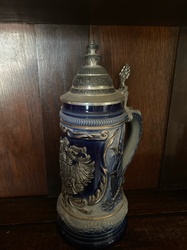
This stein appears to be a well-made, manufactured piece from the mid-20th century, a prolific period for such souvenir and collectible items. While the craftsmanship is detailed, it is characteristic of a large-scale production intended for the decorative and tourist market rather than a unique or antique piece. The market for these types of steins is stable but generally moderate. Comparables from manufacturers like Gerz, Marzi & Remy, or King-Werk from this era with similar quality and themes typically sell in the range provided.
The value is primarily driven by its decorative appeal and condition rather than rarity. While it is a high-quality example, it is not from a highly sought-after antique period (pre-1900) or a limited edition series.
It is crucial to note the limitations of an appraisal based purely on images. A physical, in-person examination is necessary to fully authenticate the piece. I would need to inspect for maker's marks on the base of the stein or inside the pewter lid, which are critical for identifying the manufacturer and dating it precisely. Verifying the pewter content and confirming the absence of any subtle repairs would also require direct handling.