AI Appraisal Estimate

AI-generated estimates · not official valuations

From the user

What was submitted

Photo and notes provided by the user — not generated by AI

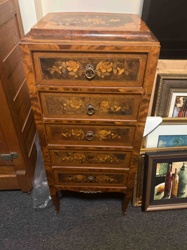
Submitted item photo
Submitted photo · May 17, 2026

User's notes

No additional notes provided.

AI analysis below

AI appraisal

AI analysis & estimate

AI-Generated · Verify before acting

Everything below is generated by AI for informational purposes only. AI can make mistakes — the AI may misidentify items or misattribute them (artist, maker, brand, designer, origin, era). This is not an official valuation and should not be used for insurance, sale, tax, estate, legal, or lending purposes — or any decision requiring a certified appraisal. It is not an authoritative claim about any person, brand, or rights holder — do not share or rely on it as a factual statement about a third party. Always consult qualified professionals before making financial decisions.

Read the full disclaimer

AI Identification

·Not independently authenticated·Verify before acting

Mediterranean Style Oak Triple Dresser with Wrought Iron Accents

Antique and Vintage Furniture

AI Estimated Value

·Not an official valuation·Verify before acting

$450 - $650

As of May 17, 2026

AI Item Analysis

·AI can make mistakes·Verify before acting
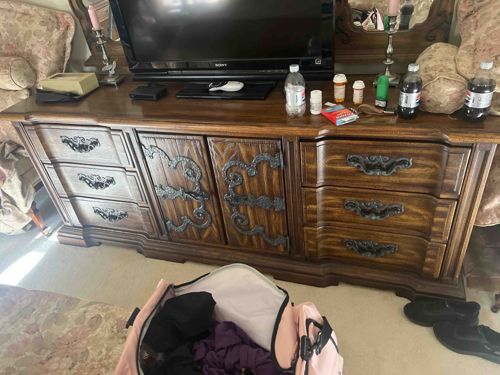
This is a large-scale, 'triple' style horizontal bedroom dresser, likely manufactured in the late 1960s to mid-1970s. The piece is constructed primarily of oak or oak veneers with a medium-to-dark walnut stain that highlights a prominent, swirled wood grain. Its design is heavily influenced by the Mediterranean Revival or Spanish Colonial style popular during that era. The front facade features a symmetrical layout with three drawers on the left, three on the right, and a central cabinet section with two hinged doors. A defining feature of this piece is the elaborate black-finished, scrolled metal hardware, which includes oversized ornate drawer pulls and decorative faux-strap hinges on the central doors made to look like hammered wrought iron. The drawer fronts and doors exhibit a molded 'concave' or scalloped profile, adding significant depth and visual texture to the piece. The base is a solid plinth-style molding that follows the undulating contours of the front. Regarding condition, the piece shows moderate surface wear consistent with age, including small scuffs along the base and minor scratches on the top surface. The construction appears sturdy, typical of mass-produced high-end furniture from American manufacturers of that period like Thomasville, Drexel, or Bassett. There are no visible maker's marks from this angle, but such marks are usually found inside the top-left drawer or stamped on the back panel.

AI Appraisal Report

·AI can make mistakes·Verify before acting
I have virtually examined this Mediterranean Revival triple dresser, a hallmark of American furniture manufacturing from the late 1960s through the mid-1970s. The piece demonstrates high-quality mass production typical of manufacturers such as Thomasville or Drexel. The heavy oak veneers and distinctive wrought iron-style scrollwork are characteristic of the Spanish Colonial influence that dominated mid-century suburban interiors. My examination of the images reveals a sturdy construction with moderate surface wear, including expected scuffs on the plinth base and minor abrasions on the top surface. The hardware appears intact, which is critical as replacing these specific 'faux-strap' hinges and matching pulls would be difficult. The current market for Mediterranean Revival furniture is steady but localized. While not as high-demand as sleek Mid-Century Modern (MCM) styles, there is a growing 'maximalist' trend that values the scale and texture of these pieces. Comparables for similar triple dressers in fair-to-good condition typically hammer between $400 and $700 at regional estate auctions. The value is bolstered by its large storage capacity but limited by its significant footprint and weight. Note that this appraisal is based on photographic evidence. A full authentication requires an in-person inspection to verify drawer joinery (dovetailing), confirm the presence of maker's marks, and ensure the 'wrought iron' is not cast plastic—a common cost-cutting measure of the era. I would also need to inspect the back panel for 'breathe' holes or stamps to rule out modern reproductions. Without physical access, I cannot verify the integrity of the drawer glides or the presence of non-original repairs.

Get your items appraised

Instant estimates of your treasures with AI-powered appraisals

Browse More Appraisals