AI estimate as of June 25, 2025 · verify with a professional before acting
AI-Generated · Verify before acting
Everything on this page is generated by AI for informational purposes only. AI can make mistakes — the AI may misidentify items or misattribute them (artist, maker, brand, designer, origin, era). This is not an official valuation and should not be used for insurance, sale, tax, estate, legal, or lending purposes — or any decision requiring a certified appraisal. It is not an authoritative claim about any person, brand, or rights holder — do not share or rely on it as a factual statement about a third party. Always consult qualified professionals before making financial decisions.
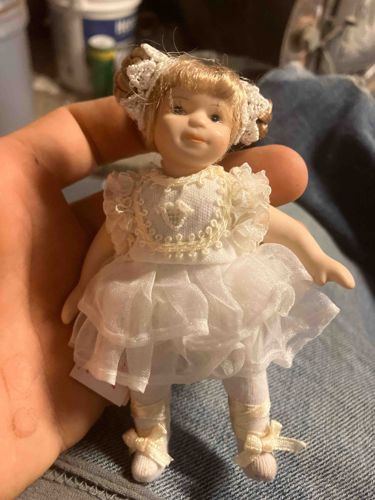
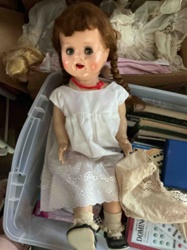
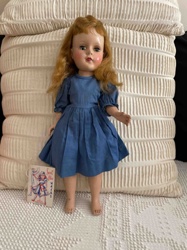
This is a miniature porcelain or bisque doll, approximately the size of a human hand, dressed in an elaborate white ballerina or ballet costume. The doll features a delicately sculpted face with painted facial features including blue eyes, a small nose, and closed lips, giving it a youthful, childlike expression. Its hair is light brown, styled with curls and possibly a tiny bun, adorned with intricate white lace accents that mimic hairnets or small ribbons tied on the sides of the head. The body appears to be articulated, with visible joints at the shoulders and hips, typical of collector's miniature dolls. The costume consists of a white bodice with fine embroidered lace applique and small pearl-like embellishments. A multi-layered, ruffled white organza or tulle tutu forms the skirt, providing a classic ballet silhouette. The legs are covered in white tights, and the feet are sculpted to represent pointe shoes or ballet slippers. Yellowish-white ribbons are wrapped around the ankles and tied into bows, mimicking traditional ballet shoe laces. The doll appears to be in good overall condition with no obvious chips, cracks, or significant wear visible from the image, suggesting careful handling. The craftsmanship indicates it is a collector's item rather than a child's toy, likely from the late 20th or early 21st century, possibly mass-produced with attention to detail for the miniature doll market.
AI Appraisal Report
After a thorough visual examination of the provided image, I can offer an appraisal of this miniature porcelain ballerina doll. The doll appears to be molded with a delicate bisque or porcelain head and articulated body, characteristic of collectible miniature dolls. Its condition appears to be excellent, with no visible chips, cracks, or significant wear on either the doll or its elaborate white ballet costume. The painted facial features are well-executed, contributing to its youthful charm. The intricate detailing of the costume, including the lace, pearl-like embellishments, multi-layered tutu, and realistic ballet shoe ties, suggests a high level of craftsmanship, likely indicating a collector's item rather than a plaything.
autenticity and Age: Based on the aesthetic and craftsmanship, I estimate this doll dates from the late 20th to early 21st century. It closely resembles mass-produced collector's miniature dolls often sold through specialized companies. Without maker's marks, original packaging, or provenance documentation, definitive authenticity and precise dating cannot be confirmed solely from an image. An in-person examination would allow for closer inspection of materials, articulation mechanisms, and any hidden marks. Microscopic analysis could provide insights into paint composition and porcelain type.
Market Conditions and Value Factors: The market for miniature collectible dolls, while niche, is generally stable but not highly speculative unless the doll is by a renowned artist, extremely rare, or part of a highly sought-after limited edition. This doll's value is primarily driven by its exquisite detail, apparent excellent condition, and its appeal as a decorative piece. Demand for such items is consistent among doll collectors, but rarity does not seem to be a significant factor in this case, as similar detailed miniature dolls were widely produced.
Limitations: My assessment is based entirely on a single image. A physical inspection would allow me to verify the material (porcelain vs. bisque), examine articulation points fully, identify any maker's marks or signatures, and confirm the overall integrity of the piece, especially any unseen damage or repairs. Without knowing the original manufacturer or artist, providing a higher valuation is not prudent.