AI estimate as of December 13, 2025 · verify with a professional before acting
AI-Generated · Verify before acting
Everything on this page is generated by AI for informational purposes only. AI can make mistakes — the AI may misidentify items or misattribute them (artist, maker, brand, designer, origin, era). This is not an official valuation and should not be used for insurance, sale, tax, estate, legal, or lending purposes — or any decision requiring a certified appraisal. It is not an authoritative claim about any person, brand, or rights holder — do not share or rely on it as a factual statement about a third party. Always consult qualified professionals before making financial decisions.
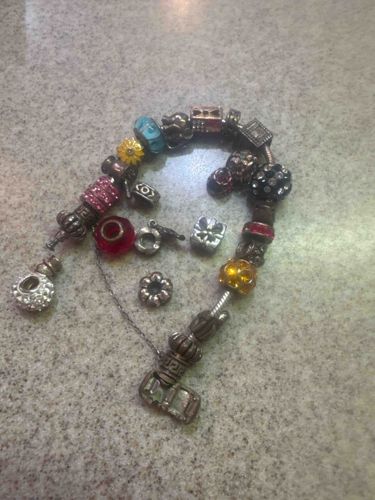
This item is an assembled charm bracelet featuring a variety of beads and charms, with several additional loose charms alongside it. The bracelet appears to be constructed from a metal chain or wire, potentially silver-toned, on which numerous decorative beads and charms are threaded. The charms exhibit a diverse range of materials, colors, and designs. Notable characteristics include several brightly colored glass or enameled beads in hues such as dark red, light blue, and yellow. Some charms are metallic with intricate detailing, such as a pink-gemmed cylindrical charm, a metallic flower-shaped charm, and other geometric or figurative designs. There's a prominent charm with multiple clear or white pave-set stones, suggesting cubic zirconia or similar-quality imitation diamonds. The overall aesthetic is consistent with popular customizable charm bracelets, such as those from brands like Pandora or Chamilia, though no specific maker's marks are discernible from the image. The condition shows some signs of wear, particularly a visible thin metal chain or wire detached or broken from one of the charms, indicating potential damage or a repair need. The metal components show some patina or oxidation, typical of aging costume jewelry or lower-purity silver alloys. The varied designs suggest a collection accumulated over time, with no consistent theme beyond individual aesthetic choice. The craftsmanship varies across the individual components, typical for mass-produced charm elements, ranging from simple metal castings to more elaborate settings for stones and enamel work. The size appears to be that of a standard bracelet, likely intended for a wrist.
AI Appraisal Report
I have examined the provided image of this assorted charm bracelet with loose charms. The bracelet displays a variety of decorative elements, including glass or enameled beads, metallic charms with detailing, and a charm featuring pave-set clear stones. The overall aesthetic is consistent with popular, mass-produced customizable charm bracelets, similar to styles from brands like Pandora or Chamilia. However, without discernible maker's marks, I cannot definitively attribute it to any specific high-end brand. The condition shows moderate wear, with some metal components exhibiting patination or oxidation, and notably, a thin metal chain or wire appears detached or broken from one of the charms, indicating a need for repair. The 'pave-set' stones are likely cubic zirconia or glass, given the overall presentation and lack of any indications of fine jewelry. This is typical for costume jewelry.
Market conditions for such items, particularly if unbranded, are largely driven by their decorative appeal rather than intrinsic material value. Comparables for unbranded, pre-owned charm bracelets with mixed-material charms typically retail in the $30-$100 range, depending on condition and quantity of charms. The loose charms might add a small premium. Demand is steady for accessible fashion jewelry, but rarity is not a factor here; similar items are widely available. The primary factors impacting value negatively are the unconfirmed origin, the costume-level materials, and the evident damage requiring repair.
It is crucial to state that this appraisal is based solely on visual inspection of the image. A full authentication would require in-person examination to verify material composition (e.g., sterling silver vs. plated base metal), confirm the nature of the stones (e.g., diamond tester for the pave-set stones), and search for any hidden maker's marks. Provenance documentation would further support authenticity claims for branded items, which is absent here. Without physical inspection, I cannot confirm the exact composition or definitively rule out low-purity precious metals, though the visual cues strongly suggest costume jewelry.