AI estimate as of August 4, 2025 · verify with a professional before acting
AI-Generated · Verify before acting
Everything on this page is generated by AI for informational purposes only. AI can make mistakes — the AI may misidentify items or misattribute them (artist, maker, brand, designer, origin, era). This is not an official valuation and should not be used for insurance, sale, tax, estate, legal, or lending purposes — or any decision requiring a certified appraisal. It is not an authoritative claim about any person, brand, or rights holder — do not share or rely on it as a factual statement about a third party. Always consult qualified professionals before making financial decisions.
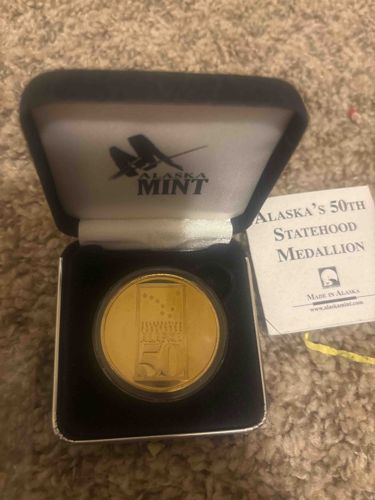
The item is an 'Alaska's 50th Statehood Medallion' presented in a black, velvet-lined display box. The box itself is rectangular with a hinged lid, featuring the 'Alaska Mint' logo debossed or printed in white on the inside of the lid. The logo depicts two stylized bears and text 'ALASKA MINT'. The medallion itself is round, appearing to be struck in a base metal with a gold-tone finish, possibly brass, bronze, or a gold-plated alloy, given the color saturation and lack of visible precious metal hallmarks. It is encased in a protective clear plastic capsule, which is then set into a custom-fitted depression within the black velvet insert of the box.
The obverse of the medallion, which is visible, features prominent numbering '50' with 'STATEHOOD' inscribed vertically above it. Above 'STATEHOOD', there appears to be a stylized representation of Alaska or perhaps a depiction of the Big Dipper constellation and Polaris, which is featured on the Alaskan flag. The background has a textured, possibly frosted finish, contrasting with the polished raised elements. The edge of the medallion may be plain or reeded, but this is not visible.
Accompanying the medallion is a white paper tag or certificate, which clearly states 'ALASKA'S 50th STATEHOOD MEDALLION'. Below this, it includes 'Made in Alaska' and the website 'www.alaskamint.com'. A yellow string is attached to the tag, suggesting it was originally tied to the box or the medallion's packaging for retail display or presentation.
The overall condition appears excellent, with no visible scratches or wear on the medallion itself, likely due to its protective capsule. The box also appears to be in very good condition, indicating careful storage. The item commemorates the 50th anniversary of Alaska's statehood, which occurred in 1959, placing its estimated age around 2009. The craftsmanship appears to be of standard minting quality for commemorative pieces, with clear detail on the design.
AI Appraisal Report
I have examined the provided image of the 'Alaska's 50th Statehood Medallion' presented in its display box. Based on this visual inspection, the item appears to be in excellent condition. The medallion itself shows no visible scratches or wear, likely due to its protective clear plastic capsule. The display box also appears very well-preserved, suggesting careful storage. Authenticity, based solely on the image, seems high for this type of commemorative item; it aligns with typical mint products for such anniversaries, manufactured by a reputable entity like the 'Alaska Mint'.
Market conditions for non-precious metal commemorative medallions are generally modest. Comparables often include similar statehood or historical anniversary medallions, which typically retail at entry-level numismatic prices. Demand for such items is primarily from local collectors, those with personal ties to Alaska, or general commemorative enthusiasts. While it celebrates a significant anniversary, these medallions are often mass-produced, limiting their individual rarity. The 'Made in Alaska' and 'Alaska Mint' branding add a regional collectible appeal, but not significant rarity.
Factors significantly impacting value include the non-precious metal composition (likely brass or bronze with a gold-tone finish), which keeps the intrinsic metal value negligible. Its primary value is driven by its commemorative nature and condition. The protective capsule and display box enhance its collectible appeal and preservation but do not dramatically increase its market value given the common nature of the item.
Limitations in authenticity verification from images alone are present. While the medallion appears genuine for its type, I cannot definitively confirm the metal composition without physical testing (e.g., specific gravity, XRF analysis). Full authentication would ideally require in-person examination to verify the tactile quality, precise dimensions, and edge characteristics that are not fully visible. Provenance documentation, such as original purchase receipts, would also strengthen its authenticity and history, though for a modern commemorative, this is less critical than for high-value numismatic pieces.