AI Appraisal Estimate

AI-generated estimates · not official valuations

From the user

What was submitted

Photo and notes provided by the user — not generated by AI

Submitted item photo
Submitted photo · June 4, 2026

User's notes

No additional notes provided.

AI analysis below

AI appraisal

AI analysis & estimate

AI-Generated · Verify before acting

Everything below is generated by AI for informational purposes only. AI can make mistakes — the AI may misidentify items or misattribute them (artist, maker, brand, designer, origin, era). This is not an official valuation and should not be used for insurance, sale, tax, estate, legal, or lending purposes — or any decision requiring a certified appraisal. It is not an authoritative claim about any person, brand, or rights holder — do not share or rely on it as a factual statement about a third party. Always consult qualified professionals before making financial decisions.

Read the full disclaimer

AI Identification

·Not independently authenticated·Verify before acting

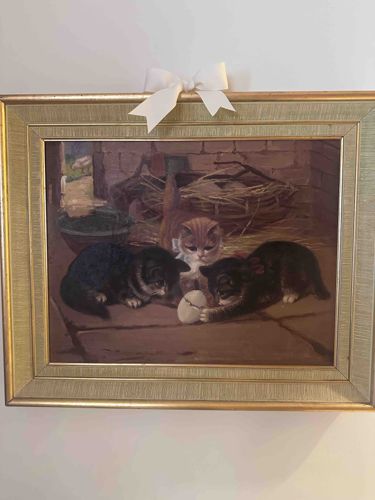
Victorian-style Narrative Painting of Three Kittens and an Egg

Fine Art / Paintings

AI Estimated Value

·Not an official valuation·Verify before acting

$150 - $300

As of June 4, 2026

AI Item Analysis

·AI can make mistakes·Verify before acting
This item is an oil on canvas or high-quality lithographic print depicting three kittens in a rustic barn-like setting. The composition centers on a ginger tabby and two dark tabby kittens playfully interacting with a cracked egg on a terracotta-tiled floor. In the background, there is a straw-filled basket and a brick wall, suggesting a traditional interior such as a stable or pantry. The piece is housed in a substantial mid-20th-century gold-colored frame featuring a vertical linear texture and a smooth inner bevel. The artwork is characterized by a warm, earth-toned palette consisting of browns, ambers, and soft ochers. The kitsch aesthetic and subject matter are reminiscent of late 19th-century Victorian animalier paintings, though the framing and surface texture suggest it may be a later reproduction or a 20th-century work in that style. A decorative white satin ribbon is currently attached to the top of the frame, which is not part of the original work. The visible condition appears stable with no major losses, although the frame shows minor edge wear and the canvas surface may have a light coating of dust or aged varnish. No signature is clearly visible in the provided image.

AI Appraisal Report

·AI can make mistakes·Verify before acting
I have virtually examined this Victorian-style narrative painting of three kittens and an egg. Based on the visual characteristics, this piece appears to be a mid-to-late 20th-century decorative work or a high-quality lithographic transfer on canvas, executed in the 19th-century 'Animalier' tradition. The composition—featuring kittens in a rustic barn setting—mimics the popular sentimental styles of artists like Henriette Ronner-Knip, though the lack of a visible signature and the standardized texture suggest a commercial production for the interior design market. The condition is fair to good. The frame shows minor edge wear consistent with mid-century age, and the canvas surface exhibits a slight dullness, likely from accumulated dust or an oxidized synthetic varnish. The inclusion of the white ribbon is non-original and decorative. The market for vintage animal kitsch remains stable, particularly for feline subjects, but the value is capped by the likely status of the work as a reproduction rather than an 19th-century original oil painting. Comparables for mass-produced mid-century feline prints in similar gilded frames typically realize between $100 and $400 at specialty decor auctions. The rarity is low, as these motifs were widely distributed in the 1950s and 60s. Limitations: This appraisal is based on photographic evidence only. A definitive determination of medium (oil vs. print) requires a physical inspection under magnification and UV light to identify dot patterns or authentic brushwork. To fully authenticate this as a 19th-century original, I would require provenance documentation, proof of canvas age via rear-side inspection of the stretcher bars, and chemical analysis of the pigments.

Get your items appraised

Instant estimates of your treasures with AI-powered appraisals

Browse More Appraisals