AI estimate as of August 25, 2025 · verify with a professional before acting
AI-Generated · Verify before acting
Everything on this page is generated by AI for informational purposes only. AI can make mistakes — the AI may misidentify items or misattribute them (artist, maker, brand, designer, origin, era). This is not an official valuation and should not be used for insurance, sale, tax, estate, legal, or lending purposes — or any decision requiring a certified appraisal. It is not an authoritative claim about any person, brand, or rights holder — do not share or rely on it as a factual statement about a third party. Always consult qualified professionals before making financial decisions.
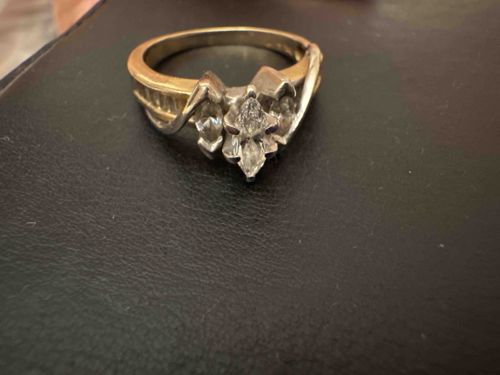
This item is a ring, appearing to be crafted from at least two different metal tones: a warmer, possibly gold-toned metal for the main band, and a cooler, silver-toned metal for the setting of the central stones. The band features a ribbed or fluted texture on its shoulders, giving it a somewhat architectural or Art Deco-inspired feel. The central design is a cluster of multiple smaller, clear stones, which appear to be either diamonds or diamond simulants. There are at least three prominent marquise or navette-cut stones forming the central focal point, flanked by smaller round or baguette-cut stones integrated into the silver-toned setting. The overall design suggests a vintage or antique aesthetic, possibly dating from the mid-20th century. The metals show signs of wear and tarnishing, particularly on the silver-toned components, indicating age and use. There are no clearly visible maker's marks or hallmarks from the provided image, which would typically be on the inside of the band. The craftsmanship appears to be of standard quality for mass-produced jewelry of its era, with no obvious signs of high-end bespoke work.
AI Appraisal Report
Based on my visual examination of the provided image, I assess this two-tone, multi-stone cluster ring. The condition appears consistent with a vintage item, showing wear and tarnishing, particularly on the cooler-toned metal setting, which suggests age and prior use. Authenticity, based solely on the image, points to it being a mass-produced vintage ring, likely from the mid-20th century as suggested by its design elements.
Regarding market conditions, similar vintage cluster rings, unless featuring natural diamonds and solid gold, typically fall into the costume or lower-end fine jewelry category. The stones appear clear, but without in-person testing, I cannot verify if they are diamonds, simulants, or white sapphires. Given the apparent mass-produced nature and lack of visible hallmarks, simulants are highly probable. Demand for such pieces is generally moderate, driven more by aesthetic appeal and sentiment than intrinsic material value. Rarity is low; many comparable rings exist from the period.
Factors significantly impacting value include the actual metal content (e.g., solid gold vs. gold-filled/plated), the nature of the stones (natural diamonds vs. simulants), and the presence of any maker's marks or historical provenance. The current wear diminishes its immediate aesthetic appeal, potentially lowering its market desirability without restoration.
Limitations in authenticity verification are significant. A definitive appraisal requires a physical examination to test the metal purity (e.g., 10k, 14k gold, or plated material) using acid tests or XRF analysis, and to identify the stones using a diamond tester, refractometer, and microscopy. I would also need to examine the interior of the band for hallmarks. Provenance documentation, if available, could add historical value. Without these in-person assessments, the value remains speculative.