These notes were written by the person who submitted this item. Appraiser.AI has not verified them, and the AI's identification and estimate may rely on them.
AI Estimated Value
Not an official valuation
$1,800 - $2,500
AI estimate as of October 26, 2025 · verify with a professional before acting
AI-Generated · Verify before acting
Everything on this page is generated by AI for informational purposes only. AI can make mistakes — the AI may misidentify items or misattribute them (artist, maker, brand, designer, origin, era). This is not an official valuation and should not be used for insurance, sale, tax, estate, legal, or lending purposes — or any decision requiring a certified appraisal. It is not an authoritative claim about any person, brand, or rights holder — do not share or rely on it as a factual statement about a third party. Always consult qualified professionals before making financial decisions.
This analysis also relies on unverified notes provided by the user, which may be incomplete or inaccurate and could affect the result.
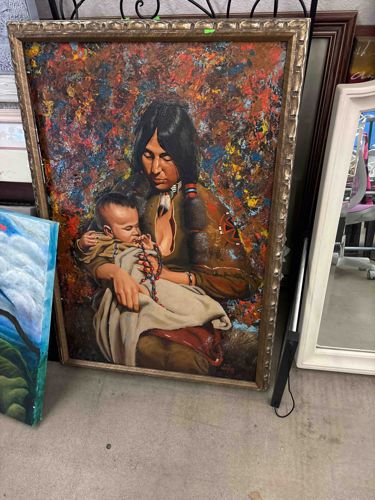
This is an oil painting on canvas titled “Mother and Child” by artist Joe Russo, dated 1974. The painting depicts a Native American woman holding an infant. The woman has dark, long hair styled with two braids, one of which is visible and adorned with a white feather or bone decoration near her shoulder. She is wearing what appears to be traditional or historically inspired brown attire and a necklace or pendant that is partially visible. Her gaze is directed downwards towards the child, suggesting affection and tenderness. The infant, wrapped in a light-colored blanket, holds a string of red, possibly coral or glass, beads, with some beads trailing down. The background of the painting is rendered in an impasto style, with a vibrant and abstract mix of reds, blues, yellows, and browns, creating a rich textural contrast to the more smoothly rendered figures. The overall color palette is earthy with bursts of bright, fragmented colors in the background. The painting is housed in a substantial gold-toned frame with ornate detailing, likely made of wood or resin, which shows some signs of age and patina. The visible quality of the brushwork, particularly in the background, indicates a skilled hand. 'Joe Russo 74' (presumably 'Joe Russo' and the year '1974') is visible as an inscription, likely the artist's signature and date. The piece exhibits a representational style with a modern, abstract twist in the background, characteristic of the mid-20th century.
AI Appraisal Report
Based on my visual examination of the provided image of Joe Russo’s ‘Mother and Child’ from 1974, I assess its condition as good, commensurate with its age. The colors appear vibrant, and the impasto background shows no obvious signs of significant paint loss or cracking from the image. The ornate gold-toned frame, while contributing to the overall presentation, shows expected signs of age and patina, which is not unusual for a piece of this vintage. The visible inscription 'Joe Russo 74' appears consistent with a signature and date, suggesting authenticity at first glance.
Market conditions for mid-20th century representational art with a modern twist, especially pieces depicting Native American themes, generally show a steady, though not rapidly escalating, demand. Comparables for artists in this regional category, working in oil on canvas with a similar blending of traditional figuration and abstract backgrounds, often fall within the $1,500 to $3,000 range. The quality of brushwork evident, particularly the textural background, suggests a skilled hand. Demand for paintings of this style by regional artists is typically stable, rather than rare, but the emotive subject matter of 'Mother and Child' makes it a universally appealing piece.
Factors significantly impacting value include the artwork's good condition and the appealing subject matter. However, the exact market standing and exhibition history of Joe Russo would be crucial in narrowing down its precise value. Without a comprehensive artist biography or sales records, establishing primary market demand for Russo's work specifically is challenging.
My assessment of authenticity is limited by the fact that I have only examined an image. While the signature appears consistent, for full authentication, an in-person examination would be necessary to verify brushstroke application, paint composition, and potential restoration. Additionally, provenance documentation, such as original purchase receipts or exhibition history, would greatly strengthen the authentication and provide a more robust basis for valuation. Scientific testing, like pigment analysis, could confirm the age and materials used, further solidifying its authenticity.