AI Appraisal Estimate

AI-generated estimates · not official valuations

From the user

What was submitted

Photo and notes provided by the user — not generated by AI

Submitted item photo
Submitted photo · June 6, 2026

User's notes

Ll pp

AI analysis below

AI appraisal

AI analysis & estimate

AI-Generated · Verify before acting

Everything below is generated by AI for informational purposes only. AI can make mistakes — the AI may misidentify items or misattribute them (artist, maker, brand, designer, origin, era). This is not an official valuation and should not be used for insurance, sale, tax, estate, legal, or lending purposes — or any decision requiring a certified appraisal. It is not an authoritative claim about any person, brand, or rights holder — do not share or rely on it as a factual statement about a third party. Always consult qualified professionals before making financial decisions.

Note

This analysis also relies on unverified notes provided by the user, which may be incomplete or inaccurate and could affect the result.

Read the full disclaimer

AI Identification

·Not independently authenticated·Verify before acting

Hand-Painted Porcelain Planter / Jardiniere

Decorative Arts

AI Estimated Value

·Not an official valuation·Verify before acting

$65-95

As of June 6, 2026

AI Item Analysis

·AI can make mistakes·Verify before acting
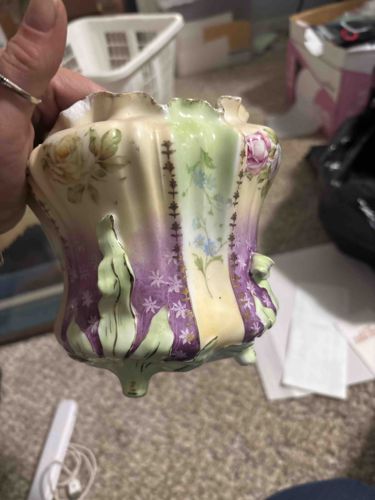
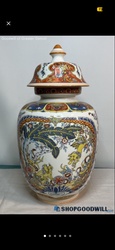
This is a vintage or antique porcelain planter or small jardiniere, characterized by its ornate and vibrant hand-painted decoration. The item is roughly cylindrical with a flared, scalloped rim, suggesting a 'shell' or 'lotus' inspired form. It features a ribbed or fluted body, with each vertical section adorned with distinct patterns and colors. The predominant colors are soft cream, various shades of purple, and light green, accented with gold gilt details. Some sections display delicate floral motifs, notably pink and yellow roses and light blue blossoms, while others show abstract patterns like vertical stripes with small gold accents or white asterisk-like stars against a purple background. The base features three small, tapered feet, typical of many turn-of-the-century decorative porcelain pieces, which are also painted to match the body's color scheme. The craftsmanship appears to be of good quality, indicated by the finely rendered details and hand-painted artistry. There are observable signs of age and wear consistent with an older item, including some loss of the gold gilt, minor scuffs, and areas where the paint might be slightly worn or faded, particularly on the raised edges. One of the feet appears to have a small chip or manufacturing imperfection. The irregular, almost organic shape of the rim further enhances its decorative appeal. Without a visible maker's mark, it is challenging to ascertain the exact manufacturer, but the style strongly suggests a late 19th to early 20th-century European (possibly German or French) origin, a period known for highly decorative porcelain. Its unique combination of colors and patterns makes it a distinctive example of antique pottery.
AI Appraisal Report

·AI can make mistakes·Verify before acting
Upon examination of the images provided, I have assessed this hand-painted porcelain planter, or jardiniere. The piece presents as a beautiful example of late 19th or early 20th-century decorative arts. The style, with its scalloped 'lotus' or 'shell' form, ribbed body, vibrant polychrome decoration, and generous gold gilt accents, is highly characteristic of European porcelain from this era, possibly of German or French origin. The delicate floral painting, particularly the roses, is skillfully executed, and the combination of floral and abstract patterns is quite distinctive. Its condition appears to be fair to good for its age, showing expected wear such as rubbing to the gilt, minor surface scuffs, and slight fading. The small chip or flaw on one of the feet is noted and slightly detracts from its value. The lack of a visible maker's mark presents a significant challenge in attribution, which is a primary factor limiting its value. Without a clear maker, such as Royal Worcester, Meissen, or a known Limoges factory, it is appraised as a high-quality decorative piece of its period. Demand for unmarked but Aesthetically pleasing turn-of-the-century porcelain is steady among decorators and collectors of the style. The market value is largely determined by its visual appeal rather than its pedigree. Based on comparable sales of similar-quality unmarked European porcelain jardinieres from the same period, the value is established. For full authentication, an in-person examination would be necessary to search for any faint or hidden marks and to properly assess the quality of the porcelain and the nature of the wear. Verifying the painter or factory would require expert analysis of the painting style and construction methods, and provenance documentation would be invaluable.

Get your items appraised

Instant estimates of your treasures with AI-powered appraisals

Browse More Appraisals