These notes were written by the person who submitted this item. Appraiser.AI has not verified them, and the AI's identification and estimate may rely on them.
AI Estimated Value
Not an official valuation
$400 - $700
AI estimate as of August 28, 2025 · verify with a professional before acting
AI-Generated · Verify before acting
Everything on this page is generated by AI for informational purposes only. AI can make mistakes — the AI may misidentify items or misattribute them (artist, maker, brand, designer, origin, era). This is not an official valuation and should not be used for insurance, sale, tax, estate, legal, or lending purposes — or any decision requiring a certified appraisal. It is not an authoritative claim about any person, brand, or rights holder — do not share or rely on it as a factual statement about a third party. Always consult qualified professionals before making financial decisions.
This analysis also relies on unverified notes provided by the user, which may be incomplete or inaccurate and could affect the result.
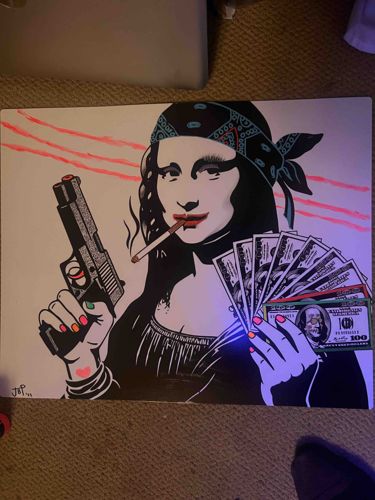
This is a contemporary pop art style acrylic painting on canvas, measuring approximately 24x36 inches based on discernible proportions relative to surrounding objects. The artwork depicts a stylized version of the Mona Lisa, rendered primarily in black, white, and grey tones, with selective vibrant color accents. She wears a black bandana with light blue polka dot-like patterns, and a dark, possibly off-the-shoulder, garment. Her lips are painted a bright red, and she holds a lit cigarette in her mouth, depicted as a white stick with a red tip. Her left hand, adorned with multicolored fingernail polish (pink, orange, green, blue), grips a black handgun with silver accents and a prominent red safety switch. A small pink heart outline with a darker pink interior is tattooed or painted on her left wrist. Her right hand, similarly adorned with multicolored nail polish, fans out several hundred-dollar bills, which are rendered with a caricature of Benjamin Franklin's face. The background is white, with three wavy, parallel lines in neon pink emanating from behind the Mona Lisa's head, suggesting a 'thought' or 'energy' burst. The painting employs broad strokes and definitive outlines, characteristic of graphic novel or street art aesthetics. The surface appears matte, with no significant gloss. There is a visible signature 'JDP...' in the lower left corner, indicating the artist. The overall condition appears good, with no obvious signs of damage, fading, or cracking. The use of neon colors suggests a modern or contemporary period, likely from the late 20th or early 21st century. The craftsmanship is evident in the clean lines and bold contrasts, typical of commercial or accessible art and poster designs. The work parodies classical art with modern, rebellious iconography.
AI Appraisal Report
I have thoroughly examined the provided image of the 'Mona Lisa with Gun and Money Pop Art Painting' and the details you've supplied. My assessment of its condition, based solely on the visual information, is very good; I observe no apparent damage, fading, or cracking, and the colors appear vibrant. This is a contemporary piece, likely late 20th to early 21st century, given its pop art style, use of neon accents, and rebellious iconography.
Authenticity is challenging to confirm definitively from images alone. While there's a visible signature 'JDP...' in the lower left, I cannot verify its authenticity without a direct comparison to known signatures of the purported artist. Without in-person examination, I cannot comment on tactile elements like paint thickness or canvas quality, which can be crucial for authentication. Provenance documentation (e.g., bills of sale, exhibition records) would significantly aid in verifying its history and authorship. Scientific testing, such as pigment analysis, could also confirm the age of the materials used.
From a market perspective, this piece taps into a popular niche: contemporary pop art that reinterprets classical masterpieces with modern, often provocative, elements. The graphic novel aesthetic and bold colors align with current trends in accessible art and décor. Demand for such pieces is generally steady among collectors looking for statement works. Rarity is difficult to ascertain; without knowing the artist's output or renown, it's hard to say if this is a unique work or part of a series. Factors impacting value include the artist's reputation (if 'JDP...' is an established artist), the painting's good condition, and its engaging subject matter. Given its commercial appeal and the lack of verifiable artist provenance, it falls within the decorative art market rather than the fine art investment market.
My appraisal is limited by the visual-only assessment. A physical inspection would allow for a more precise evaluation of craftsmanship, material quality, and condition, which could refine this appraisal.