AI estimate as of October 23, 2025 · verify with a professional before acting
AI-Generated · Verify before acting
Everything on this page is generated by AI for informational purposes only. AI can make mistakes — the AI may misidentify items or misattribute them (artist, maker, brand, designer, origin, era). This is not an official valuation and should not be used for insurance, sale, tax, estate, legal, or lending purposes — or any decision requiring a certified appraisal. It is not an authoritative claim about any person, brand, or rights holder — do not share or rely on it as a factual statement about a third party. Always consult qualified professionals before making financial decisions.
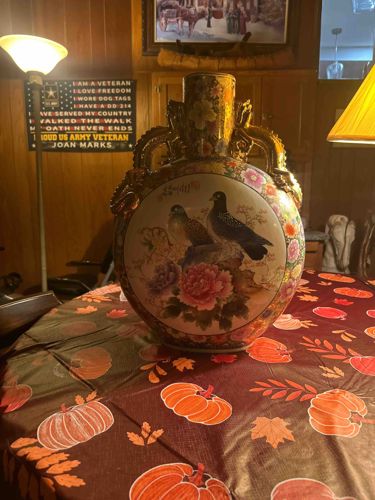
This is a large, flat-backed ceramic vase, often referred to as a 'moon flask' due to its distinct flattened spherical body. It features elaborate polychrome decoration in what appears to be the 'Famille Rose' style, characterized by a dominant palette of pinks, greens, and yellows, common in Chinese porcelain. The main body of the flask displays a central medallion on its visible side with a detailed hand-painted scene of two birds (possibly doves or pigeons) perched amidst lush, vibrant peonies and other floral elements. The background of this medallion is a light, perhaps off-white or pale yellow, providing a soft contrast to the rich colors of the birds and flowers. The rest of the flask's body surrounding the medallion is adorned with a dense floral pattern, suggesting a continuous wrapping design. The neck of the vase is relatively thin and tall, also decorated with complementary floral motifs. A prominent feature of this piece is the pair of ornate, apparently gilded or metallic-colored, dragon-like handles that arch from the shoulders of the flask up to the sides of the neck. These handles appear to be applied three-dimensional elements, adding to the grandeur and complexity of the design. The overall condition appears good from the visible angle, showing no obvious breaks or large chips, although typical age-related wear, light surface scratches, or minor paint loss would be expected with an item of this type. The craftsmanship suggests a decorative and potentially ceremonial piece, indicative of mid-20th century to contemporary production, although without maker's marks, a precise age is difficult to ascertain.
AI Appraisal Report
Based on my visual examination of the provided image, this large Chinese Famille Rose moon flask vase presents as a very attractive decorative ceramic piece. The polychrome decoration is vibrant, detailed, and consistent with the Famille Rose palette, featuring a central medallion with birds amidst peonies and dense floral patterns elsewhere. The gilded dragon-form handles are a prominent feature, adding to its visual appeal and perceived value. From the image, the condition appears good, showing no obvious damage such as significant chips, cracks, or repairs. However, a physical inspection would be crucial to confirm this, as minor paint loss, fine crazing, or subtle repairs are often undetectable from photographs.
Assessing authenticity is challenging from an image alone. The style and decoration suggest a piece likely from the mid-20th century to contemporary production, rather than an older, imperial-era example. The execution, while skilled, doesn't immediately suggest the exceptional fineness and particularity often found in genuine antique pieces. For full authentication, I would need to physically examine the clay body, the quality of the glazes, the painting technique up close, the wear to the base, and search for any maker's marks or reign marks that might be present. Provenance documentation, if available, would also be invaluable in establishing its history and potential age.
In terms of market conditions, decorative Chinese porcelain, particularly attractive and well-crafted pieces like this, generally enjoys a stable demand. While not ancient, such pieces appeal to collectors of chinoiserie and those seeking elaborate decorative accents for interiors. Comparables in this price range often include similarly sized and decorated Famille Rose style vases from the mid-20th century, typically selling at auction or through retail for several hundred to over a thousand dollars, depending on perceived age, condition, and market trends. The size and intricate decoration are positive factors for value.
The rarity of such pieces is moderate; while not unique, not every example is as visually striking as this one. The dragon handles and the detailed bird and flower motif elevate its desirability. The primary factor impacting value, beyond condition, is definitively establishing its age and origin. Without in-person inspection and potential scientific testing (e.g., thermoluminescence for absolute dating), I can only appraise this as a high-quality decorative item, presuming a 20th-century origin, which places it in the $600-$900 range.