AI estimate as of July 14, 2025 · verify with a professional before acting
AI-Generated · Verify before acting
Everything on this page is generated by AI for informational purposes only. AI can make mistakes — the AI may misidentify items or misattribute them (artist, maker, brand, designer, origin, era). This is not an official valuation and should not be used for insurance, sale, tax, estate, legal, or lending purposes — or any decision requiring a certified appraisal. It is not an authoritative claim about any person, brand, or rights holder — do not share or rely on it as a factual statement about a third party. Always consult qualified professionals before making financial decisions.
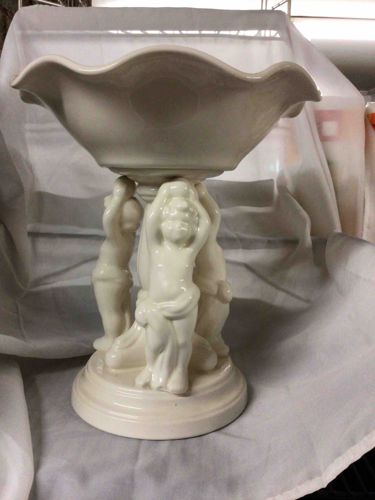
This item is a decorative footed bowl or compote, likely crafted from ceramic or glazed pottery, indicated by its off-white or cream color and its smooth, somewhat reflective surface. The centerpiece of the design is the bowl itself, which features an elegant, undulating or ruffled rim, suggesting a floral or shell-like influence. The bowl is supported by a sculptural base consisting of three classical figures, most likely putti or cherubs, depicted in various poses as if holding up the bowl. These figures are rendered with noticeable detail in their faces, hair, and drapery, with one figure prominently featured in the foreground, seemingly looking forward. The base itself is circular and stepped, providing stability to the piece. The overall construction appears to be molded, with some evidence of seam lines potentially visible upon closer inspection, though not overtly apparent in the provided images. The item exhibits a consistent color throughout, suggesting a uniform glaze. There are no obvious signs of significant damage such as chips, cracks, or repairs, though a subtle patina or slight discoloration might be present due to age, which is common for such ceramic pieces. The style strongly suggests a mid-20th-century aesthetic, possibly inspired by neoclassical or romantic design elements, often seen in decorative household items from that period. The craftsmanship appears to be of good quality, focusing on aesthetic appeal rather than utilitarian robustness, as is typical for decorative ceramics.
AI Appraisal Report
Based on my visual examination of the provided image, this Ivory Ceramic Ruffled Bowl with Cherub Pedestal Base appears to be in very good condition. I observe no overt chips, cracks, or significant repairs, and the glaze appears consistent across the piece. The off-white color and detailed molding of the cherubic figures suggest a decorative item from the mid-20th century, consistent with a neoclassical or romantic aesthetic. Authenticity, based solely on this image, seems plausible for a period piece; however, a definitive determination would require in-hand inspection to check for maker's marks, specific ceramic body characteristics, and the precise feel of the glaze which can indicate true age and origin.
Market conditions for decorative ceramic compotes of this style are generally stable but not exceptionally strong for mass-produced items. Comparables include similar decorative footed bowls from the mid-20th century by un-renowned manufacturers, which typically fetch between $70-$150. While its design is charming, there are no indicators of rare artistic merit or manufacturing techniques that would dramatically increase its value. Demand is moderate, primarily from collectors of vintage home decor. Factors positively impacting value include its seemingly excellent condition and aesthetically pleasing design.
Limitations in authenticity verification are significant without physical examination. I cannot ascertain the specific type of ceramic, the presence or absence of manufacturer's marks, or detect subtle repairs or restorations that might not be visible in a photograph. Provenance documentation, though unlikely for such an item, would also add significant value and authenticity. Scientific testing, such as thermoluminescence dating, would be overkill for an item in this value range but could definitively determine age.