AI estimate as of September 27, 2025 · verify with a professional before acting
AI-Generated · Verify before acting
Everything on this page is generated by AI for informational purposes only. AI can make mistakes — the AI may misidentify items or misattribute them (artist, maker, brand, designer, origin, era). This is not an official valuation and should not be used for insurance, sale, tax, estate, legal, or lending purposes — or any decision requiring a certified appraisal. It is not an authoritative claim about any person, brand, or rights holder — do not share or rely on it as a factual statement about a third party. Always consult qualified professionals before making financial decisions.
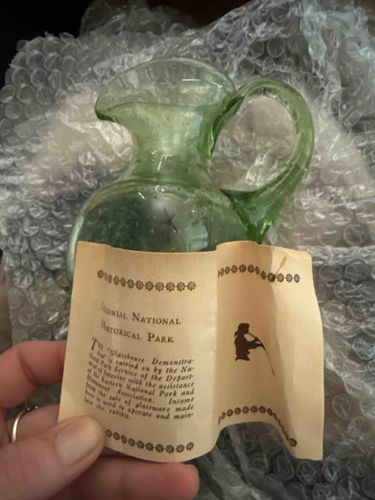
This item consists of a light green, clear glass pitcher accompanied by a small, folded informational booklet. The pitcher features a classic, somewhat conical body that tapers to a narrower neck, which then flares out to a gentle spout. A C-shaped handle is attached to the side, extending from just under the rim to the upper body, exhibiting a comfortable grip design. The glass appears hand-blown, characterized by slight irregularities, visible bubbles within the glass (indicative of older glassmaking techniques), and a somewhat uneven surface texture, suggesting artisanal craftsmanship rather than mass machine production. The color is a subtle, pale green, often associated with natural iron impurities in sand used in early glass manufacturing, or intentionally added for aesthetic reasons. The pitcher's base is not clearly visible, but the overall structure suggests a sturdy, utilitarian piece. No obvious cracks, chips, or significant damage are apparent, although detailed inspection of the rim and base would be necessary for a full condition report. The accompanying booklet, made of aged, light brown paper, reads 'COLONIAL NATIONAL HISTORICAL PARK' and describes 'The 'Glasshouse Demonstra-' being carried on by the National Park Service in conjunction with the Eastern National Park and Memorial Association. It states that income from the sale of glassware made there is used to operate and maintain the historical site. The booklet features a decorative border of floral-like motifs and a silhouette graphic of a colonial-era figure blowing glass. This provenance strongly suggests the pitcher is a replica or souvenir piece, historically made at the Colonial National Historical Park's glass blowing demonstration, likely dating from the mid-20th century to the present day. The craftsmanship points to a tourist item of good quality, designed to evoke historical glassmaking.
AI Appraisal Report
I have examined the provided image of the Colonial National Historical Park Glass Pitcher with its accompanying informational booklet. The pitcher, a light green, clear glass piece, exhibits characteristics consistent with hand-blown glass, such as subtle irregularities, visible air bubbles, and an uneven surface texture. These features, along with the pale green tint often seen in early glass or intentional coloration, point towards artisanal craftsmanship rather than mass machine production. From the image, the pitcher appears to be in good overall condition, showing no obvious chips, cracks, or significant damage. However, a detailed in-person inspection of the rim, spout, base, and handle attachment points would be necessary to confirm the absence of subtle flaws or repairs. The accompanying aged booklet, clearly linking the pitcher to the 'Colonial National Historical Park' and its 'Glasshouse Demonstrations,' establishes the item's provenance as a souvenir piece created at the historical site, likely from the mid-20th century onwards. This significantly impacts its identity; it is not an antique historical artifact, but rather a historically inspired replica or tourist item. While well-made, its value is primarily as a collectible souvenir. Similar glass items from historical park glassblowing demonstrations tend to have a niche market. Demand is generally from collectors of park memorabilia or those with a personal connection to the site. Rarity is low to moderate, given continuous production. Factors impacting value include its good condition, the clear provenance provided by the booklet, and the aesthetic appeal of artisanal glass. Without physical examination, I cannot definitively assess glass composition, internal stress, or minute surface abrasions. Authenticity of the glass as specifically from the park's demonstration is strongly supported by the booklet, but without a signature or maker's mark directly on the glass, that connection relies solely on the accompanying paper, which itself could be separated. This is generally accepted for such souvenir items. Based on current market comparables for historical park souvenir glassware, I would place the appraisal value in the range of $40-70.