AI estimate as of November 16, 2025 · verify with a professional before acting
AI-Generated · Verify before acting
Everything on this page is generated by AI for informational purposes only. AI can make mistakes — the AI may misidentify items or misattribute them (artist, maker, brand, designer, origin, era). This is not an official valuation and should not be used for insurance, sale, tax, estate, legal, or lending purposes — or any decision requiring a certified appraisal. It is not an authoritative claim about any person, brand, or rights holder — do not share or rely on it as a factual statement about a third party. Always consult qualified professionals before making financial decisions.
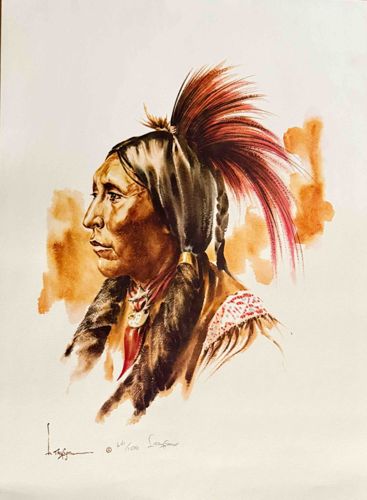
This item is a limited edition print, likely a giclée or lithograph, depicting a profile portrait of an Indigenous man wearing a traditional feathered headdress and a beaded necklace. The artwork utilizes a watercolor-like aesthetic, characterized by fluid brushstrokes and washes of color, particularly in the background which features soft, diffused orange and brown tones. The primary subject's skin tone is rendered in warm earth tones, highlighting his facial features, including a prominent nose and contemplative expression. His hair is depicted in dark browns and blacks, styled into braids that fall on his shoulders, with a distinctive, upright feathered headdress dominating the upper part of the composition. The feathers in the headdress show vibrant hues of red and pink, contrasting with his darker hair and clothing. He wears what appears to be a red neck scarf or fabric, and a detailed, possibly beaded, necklace with an ornate central pendant. The visible portion of his garment on the right shoulder suggests an intricate, perhaps embroidered or beaded, pattern in white and red. The print is on a light-colored, possibly off-white, paper substrate. In the lower left corner, there are distinct annotations: a handwritten 'Lafaye' signature, followed by what appears to be an edition number '66/100', and another signature, possibly a second artist or an authentication mark. The overall condition appears good, with no obvious creases, tears, or significant discoloration visible in the image. The print exhibits good color saturation and detail, indicative of a quality printing process. The style leans towards realistic portraiture with artistic flourishes.
AI Appraisal Report
I have examined the image provided for this limited edition print titled 'Indian Headress'. Based on my visual assessment, the print appears to be in good overall condition. I observe strong color saturation, crisp details, and no overt signs of creasing, tearing, or significant discoloration. The artwork itself, with its watercolor-like aesthetic and detailed rendering of the subject, suggests a professional-grade limited edition print, likely a giclée or lithograph. The handwritten signature 'Lafaye' and the edition number "66/100" indicate its status as a limited edition. The additional signature may be an artist's proof mark or a co-signature.
Market conditions for limited edition prints by lesser-known or regional artists tend to be moderate. While the subject matter is visually striking and appeals to collectors of Indigenous-themed art or portraiture, the primary demand driver often relates to the artist's established market presence and provenance. Comparable works by artists with similar skill levels and subject matter, but without extensive auction records or gallery representation, typically fall within the sub-$1000 range. The limited edition status (100 impressions) adds a degree of rarity, which positively impacts value, but not to the extent of major market artists.
Factors significantly impacting value include the clear signature and edition number. However, the biggest limitation in providing a definitive appraisal is the inability to verify the authenticity of the signature 'Lafaye' from an image alone. In-person examination would allow for physical inspection of the print medium, signature characteristics, and printing technique. Furthermore, provenance documentation (e.g., certificate of authenticity, purchase receipts) would be crucial to confirm the artist's identity and the print's history. Without these, authentication remains speculative, influencing the conservative appraisal range provided.