AI estimate as of October 18, 2025 · verify with a professional before acting
AI-Generated · Verify before acting
Everything on this page is generated by AI for informational purposes only. AI can make mistakes — the AI may misidentify items or misattribute them (artist, maker, brand, designer, origin, era). This is not an official valuation and should not be used for insurance, sale, tax, estate, legal, or lending purposes — or any decision requiring a certified appraisal. It is not an authoritative claim about any person, brand, or rights holder — do not share or rely on it as a factual statement about a third party. Always consult qualified professionals before making financial decisions.
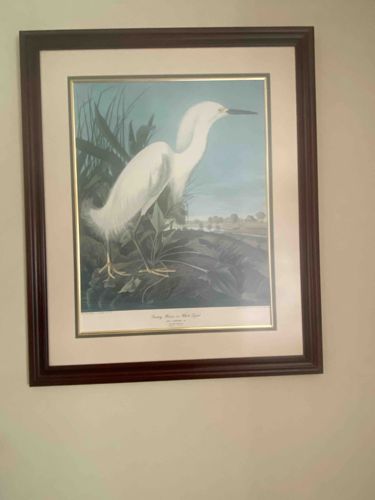
This item is a framed art print featuring a depiction of a snowy egret. The print showcases a large, elegant white bird, presumably a snowy egret, standing amidst lush green marsh vegetation. The background features a serene blue sky and what appears to be a body of water or distant landscape. The egret is rendered with fine details, highlighting its distinctive white plumage and slender form. The print is housed within a multi-layered framing system. Directly surrounding the print is a narrow, light gold-colored inner frame or fillet, which adds a subtle decorative border. This is then surrounded by a wider, off-white or cream-colored matboard, providing ample negative space that helps to emphasize the artwork. The outermost layer is a robust wooden frame with a rich, dark brown finish, possibly mahogany or a similar stained wood. The frame has a classic profile with a few subtle stepped or beveled edges, indicating a traditional and sturdy construction. The print itself appears to be in good condition with no visible creases, tears, or significant discoloration. The glass or acrylic covering the print also appears clean and clear. The overall aesthetic suggests a focus on natural history illustration, possibly a reproduction of a historical bird print (e.g., Audubon style) or a contemporary take on the genre. The legible text at the bottom appears to read "Snowy Egrot in High Grass," confirming the subject. The framing seems professionally done, contributing to the item's presentation and preservation. Given the classic styling and subject matter, it likely dates from the late 20th or early 21st century.
AI Appraisal Report
I have examined the provided image of the framed 'Snowy Egret in High Grass' art print. Visually, the print appears to be in very good condition, with no visible creases, tears, or significant discoloration. The framing, comprising a gold inner fillet, an off-white matboard, and a robust dark brown wooden frame with classic profiling, appears professionally executed and sound, enhancing the print's presentation and preservation. The clean glass also contributes to its overall well-maintained appearance.
This item represents a decorative art print, likely a reproduction, given its subject matter and presentation style. While the text "Snowy Egrot in High Grass" is visible, I cannot ascertain if this is a signed print, a limited edition, or a mass-produced item without direct physical inspection. The aesthetic aligns with popular natural history illustration, appealing to a broad demographic interested in wildlife art or traditional décor.
Market conditions for decorative art prints, particularly reproductions, are generally moderate. Demand exists for well-framed and visually appealing pieces, but rarity is typically low unless it's a signed, limited edition by a recognized artist or a rare vintage print with provenance. Comparables in the retail market for similar framed decorative prints range from $50 to $200, depending on size, framing quality, and perceived artistic merit.
Factors significantly impacting value here are the quality of the print itself (e.g., giclée vs. standard offset lithography), whether it's an original limited edition or a signed piece, and the artist's recognition. Without this information, it's difficult to assign a higher value.
Limitations in authenticity verification are significant. From an image alone, I cannot verify the print's medium, the quality of the paper, the presence of an artist's signature (which would greatly impact value), or whether it's part of a limited edition run. For full authentication and to ascertain if this is more than a decorative reproduction, an in-person examination would be essential to inspect the print's surface, paper quality, printing technique, and to look for any hidden markings, signatures, or edition numbers. Provenance documentation, if available, would also be critical to confirm its history and origin.