AI estimate as of November 28, 2025 · verify with a professional before acting
AI-Generated · Verify before acting
Everything on this page is generated by AI for informational purposes only. AI can make mistakes — the AI may misidentify items or misattribute them (artist, maker, brand, designer, origin, era). This is not an official valuation and should not be used for insurance, sale, tax, estate, legal, or lending purposes — or any decision requiring a certified appraisal. It is not an authoritative claim about any person, brand, or rights holder — do not share or rely on it as a factual statement about a third party. Always consult qualified professionals before making financial decisions.
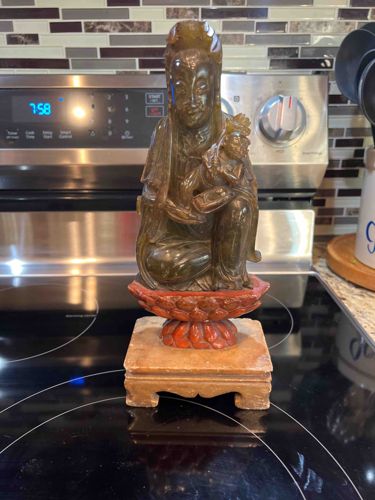
This item is a figural carving depicting Guanyin (Kuan Yin), the Buddhist Bodhisattva of Compassion, holding a child. The primary carving appears to be rendered in a deep olive-green to brown-hued stone, possibly serpentine or jade, exhibiting natural variations and veins within its material. Guanyin is depicted seated or kneeling, draped in flowing robes that are intricately carved to show pleats and folds. Her hair is stylized with a prominent topknot, and her facial features are rendered with a serene expression. She holds a small child figure, also adorned in robes and with detailed headwear, close to her body. The craftsmanship reveals fine details in the figures' hands, drapery, and facial expressions, suggesting a moderate to high level of skill. The overall piece measures approximately 10-12 inches in height based on its appearance relative to the kitchen range it's sitting on. There are no immediately visible cracks, chips, or significant damage to the main figure, though natural inclusions in the stone are present. The Guanyin figure is seated upon a separate, elaborately carved lotus-form base, which is reddish-orange in color, likely a different type of stone or possibly painted wood, adding a striking contrast. This base, in turn, rests on a rectangular, footed stand made of a lighter, off-white or yellowish stone, possibly marble or alabaster, with a more simple, traditional Asian-inspired design featuring slightly curved feet. The stand shows some signs of age and possibly slight discoloration or minor surface wear. The combination of materials and styles points to a piece with potential age, likely 20th-century Asian artistry, possibly mid-century or earlier. The detailed carving and multi-component assembly highlight its decorative and potentially spiritual significance.
AI Appraisal Report
Based on my visual examination of the provided image, this Carved Stone Guanyin with Child Figure on Lotus Base presents as a decorative and potentially collectible item. The primary Guanyin figure, carved from what appears to be a dark olive-green to brown stone (likely serpentine or a type of jade), exhibits fine craftsmanship in the drapery, facial features, and the small child figure. The condition appears good, with no visible chips or cracks. Natural stone inclusions are present, which are typical for such materials.
The multi-component construction, featuring a contrasting reddish-orange lotus base and a lighter stone stand, adds to its aesthetic appeal. This layering of materials suggests a deliberate design, characteristic of 20th-century Asian artistry, possibly mid-century. Current market conditions for similar decorative Asian stone carvings of this size and detail suggest a moderate demand. While not exceedingly rare, well-executed pieces maintain interest among collectors of Asian art and spiritual iconography.
The primary limitations in authentication stem from the image-only examination. Without physical inspection, I cannot definitively determine the exact type of stone for the Guanyin figure (e.g., distinguishing between serpentine, jadeite, or nephrite, which significantly influences value), nor can I confirm the material of the base and stand. An in-person examination would allow for tactile assessment, specific gravity testing for stone identification, and closer inspection for minute damage or repairs. Provenance documentation could provide crucial historical context, particularly regarding its origin and age. Without these, the authenticity as a period piece and the precise material composition remain estimations. My valuation considers it as an attractive decorative item of reasonable quality, rather than a museum-grade antiquity.