AI estimate as of November 3, 2025 · verify with a professional before acting
AI-Generated · Verify before acting
Everything on this page is generated by AI for informational purposes only. AI can make mistakes — the AI may misidentify items or misattribute them (artist, maker, brand, designer, origin, era). This is not an official valuation and should not be used for insurance, sale, tax, estate, legal, or lending purposes — or any decision requiring a certified appraisal. It is not an authoritative claim about any person, brand, or rights holder — do not share or rely on it as a factual statement about a third party. Always consult qualified professionals before making financial decisions.
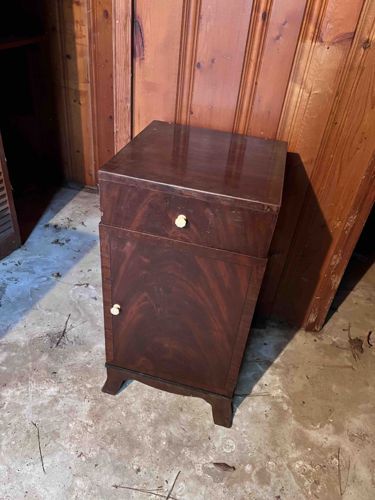
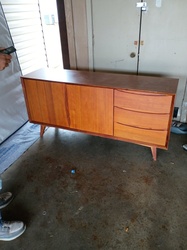
This appears to be a small side cabinet, likely constructed from a rich, reddish-brown wood that mimics the grain patterns of mahogany, or it could be mahogany veneer. The overall dimensions suggest it's a compact piece, suitable for use as a bedside table or an accent piece in a living area. It features a straightforward rectangular top with a visible sheen, indicating a polished or lacquered finish. Below the top, there is a single drawer positioned centrally, identifiable by a small, round, bone-colored or light wooden knob. Beneath the drawer, there is a larger cabinet section, enclosed by a single door, also equipped with a matching bone-colored or light wooden knob located off-center on the right side. The grain of the wood on the drawer front and the cabinet door exhibits a distinctive, wavy or swirled pattern known as 'flame grain' or 'figured grain,' which adds visual interest and suggests careful wood selection for these prominent panels. The construction appears to be solid, with clean lines, though the joints are not clearly visible. The cabinet stands on four bracket feet, two of which are visible on the front, providing stability and a subtle decorative element. The visible condition suggests some surface wear consistent with age and use; there might be minor scratches or scuffs, and possibly some dust or debris evident around the base in the image, but no major structural damage or repairs are immediately apparent. The finish shows some reflections, indicating it retains a good level of its original polish, though it could benefit from cleaning. Based on its style, particularly the simple lines and bracket feet, it could date from the mid-20th century, possibly adhering to a Classic Revival or traditional aesthetic. The craftsmanship seems of decent quality, with attention paid to the wood grain on the primary facings. There are no discernible maker's marks or signatures visible in the image.
AI Appraisal Report
Upon visual examination of the provided image, I assess this Mahogany Style Side Cabinet with Single Drawer and Cabinet Door. The item presents as a compact, utilitarian piece likely from the mid-20th century. Its construction in a rich, reddish-brown wood, potentially mahogany veneer, displays a pleasing 'flame grain' on the drawer and door fronts, suggesting a conscious effort in wood selection for aesthetic appeal. The overall condition appears good for its age, with minor surface wear such as scuffs or scratches, consistent with use. I note the presence of what appear to be original bone-colored or light wooden knobs and bracket feet, which contribute to its traditional aesthetic.
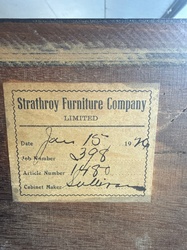
From images alone, I cannot definitively confirm the wood species or construction methods (e.g., solid wood vs. veneer, type of joinery). Without in-person inspection, authenticity regarding the specific wood (true mahogany vs. mahogany-stained) and period (mid-century vs. reproduction) remains an educated estimation. To fully authenticate, I would require a physical examination for joinery assessment, wood grain analysis, and potential identification of maker's marks, which are not visible here.
In terms of market conditions, similar mid-century side cabinets of decent quality but without designer provenance are generally considered decorative and functional rather than high-value antiques. They populate the secondary market through auction houses, consignment stores, and online platforms. The demand is moderate, driven by individuals seeking functional decor with a vintage aesthetic. This piece is not rare. Factors impacting value include its good, albeit used, condition, and its versatile size. However, the lack of definitive maker identification, coupled with it being a common furniture form, limits its potential for higher valuation. If it were confirmed to be solid mahogany with superior joinery, the value could increase, but based on current observations, it remains a sturdy, attractive, mass-produced or small-workshop piece.