AI estimate as of October 2, 2025 · verify with a professional before acting
AI-Generated · Verify before acting
Everything on this page is generated by AI for informational purposes only. AI can make mistakes — the AI may misidentify items or misattribute them (artist, maker, brand, designer, origin, era). This is not an official valuation and should not be used for insurance, sale, tax, estate, legal, or lending purposes — or any decision requiring a certified appraisal. It is not an authoritative claim about any person, brand, or rights holder — do not share or rely on it as a factual statement about a third party. Always consult qualified professionals before making financial decisions.
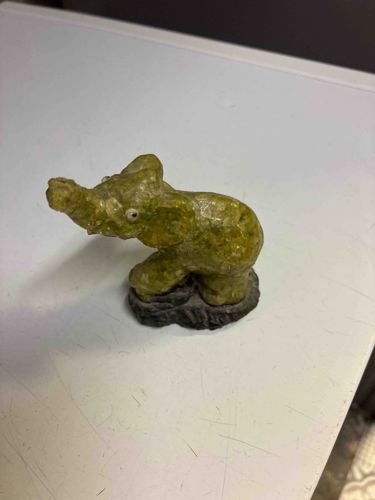
This item is a small, carved figurine depicting an elephant, likely a baby elephant or calf, given its proportions and posture. The elephant is crafted from a translucent to semi-translucent green material, possibly a type of serpentine, jadeite, or dyed quartz, exhibiting mottled coloring with lighter and darker green inclusions and striations, characteristic of natural stone. The surface has a somewhat polished but irregular texture, suggesting hand-carving. The elephant stands on what appears to be a dark, possibly black or dark gray, irregular base molded to simulate natural ground or rock. Its form is compact, with legs positioned as if taking a step or playfully rearing. Notable features include small, round, white eyes, which appear to be inlaid or painted, adding a touch of distinctness to the otherwise monochromatic body. The trunk is raised upward and slightly curled, a common pose for elephants, often symbolizing good luck. The ears are relatively large and flat against the head. The overall craftsmanship suggests a folk art or souvenir quality, rather than fine sculptural detail. There are no obvious visible condition issues such as chips or cracks from the provided image, but the irregular surface might obscure minor imperfections. The style points to a mid-20th century to contemporary creation, likely mass-produced or made in a workshop setting. The specific dimensions are not discernible but it appears to be a small decorative piece, probably no more than a few inches in height. The base is an integral part of the piece, providing stability and a naturalistic setting.
AI Appraisal Report
Based on my visual examination of the provided image, this carved green stone elephant figurine appears to be a decorative item of modest value. The material, likely serpentine or a similar translucent green stone, exhibits natural mottling and striations, consistent with its probable origin as a semi-precious ornamental stone. The craftsmanship suggests a folk art or souvenir quality, with a somewhat irregular polished surface indicating hand-carving. The inlaid white eyes add a distinct, somewhat charming, feature.
From the image, the condition appears good, with no obvious chips or cracks. However, without a physical inspection, minor abrasions or surface imperfections inherent to its irregular texture could be overlooked. The authenticity of the material as natural stone seems credible for the type of item it represents, but I cannot definitively confirm its specific geological classification (e.g., jadeite vs. serpentine vs. dyed quartz) or rule out synthetic materials without in-person examination and potentially scientific testing (e.g., refractometry, density testing).
Market conditions indicate strong demand for elephant figurines as symbols of good luck and prosperity, particularly in the souvenir and decorative arts markets. However, pieces of this quality and suspected origin are relatively common, limiting rarity. Comparable items, often found in 'new age' shops, tourist markets, or online craft platforms, typically retail within the $20-$100 range, depending on size, specific material, and perceived artistry. This piece falls into the lower to middle end of that spectrum given its illustrative rather than fine art quality.
Key factors impacting value are the decorative appeal and assumed natural material. The lack of fine detail, known artist, or historical significance precludes a higher valuation. To fully authenticate the stone type and confirm condition, a hands-on examination would be necessary.