Early 19th-Century English Mahogany Tall Case Clock
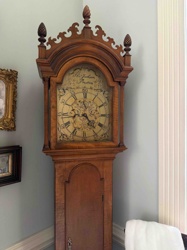
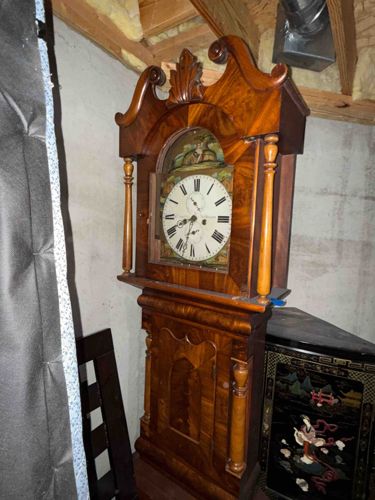
This is a significant English tall case clock (grandfather clock) crafted in the late Georgian or early Victorian style, likely dating from 1820 to 1840. The case is constructed from high-quality mahogany with flame mahogany veneers and cross-banded details. The hood features a prominent swan-neck pediment decorated with a central carved wood finial and is supported by elegant, turned wooden columns. The white-painted iron dial is adorned with a hand-painted pastoral or landscape lunar arch scene and floral spandrels at the corners. It features Roman numerals, a secondary seconds dial, and a calendar aperture. The lower case is flanked by reeded or turned quarter-columns and features a shaped trunk door with a scalloped top edge, resting on a plinth base. Physically, the wood retains a rich, warm patina, although there is visible surface wear, cracking to the veneers on the plinth, and significant dust accumulation from storage in an unfinished basement. The dial shows some crazing and minor paint loss near the center arbor. The presence of the winding holes suggests an eight-day striking movement. This piece represents high-level provincial craftsmanship with decorative wood selection meant to signify status and wealth during its era.

AI-Generated Appraisal Disclaimer
Estimated Value
$1,200 - $1,800
Basic Information
Category
Antique Furniture and Horology
Appraised On
April 10, 2026
Estimated Value
$1,200 - $1,800
Item Description
This is a significant English tall case clock (grandfather clock) crafted in the late Georgian or early Victorian style, likely dating from 1820 to 1840. The case is constructed from high-quality mahogany with flame mahogany veneers and cross-banded details. The hood features a prominent swan-neck pediment decorated with a central carved wood finial and is supported by elegant, turned wooden columns. The white-painted iron dial is adorned with a hand-painted pastoral or landscape lunar arch scene and floral spandrels at the corners. It features Roman numerals, a secondary seconds dial, and a calendar aperture. The lower case is flanked by reeded or turned quarter-columns and features a shaped trunk door with a scalloped top edge, resting on a plinth base. Physically, the wood retains a rich, warm patina, although there is visible surface wear, cracking to the veneers on the plinth, and significant dust accumulation from storage in an unfinished basement. The dial shows some crazing and minor paint loss near the center arbor. The presence of the winding holes suggests an eight-day striking movement. This piece represents high-level provincial craftsmanship with decorative wood selection meant to signify status and wealth during its era.
Related Tags
Get Your Items Appraised
Instant estimates of your treasures with AI-powered instant appraisals