These notes were written by the person who submitted this item. Appraiser.AI has not verified them, and the AI's identification and estimate may rely on them.
AI Estimated Value
Not an official valuation
$25-50
AI estimate as of July 24, 2025 · verify with a professional before acting
AI-Generated · Verify before acting
Everything on this page is generated by AI for informational purposes only. AI can make mistakes — the AI may misidentify items or misattribute them (artist, maker, brand, designer, origin, era). This is not an official valuation and should not be used for insurance, sale, tax, estate, legal, or lending purposes — or any decision requiring a certified appraisal. It is not an authoritative claim about any person, brand, or rights holder — do not share or rely on it as a factual statement about a third party. Always consult qualified professionals before making financial decisions.
This analysis also relies on unverified notes provided by the user, which may be incomplete or inaccurate and could affect the result.
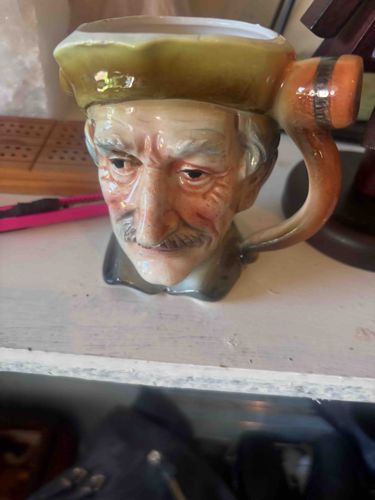
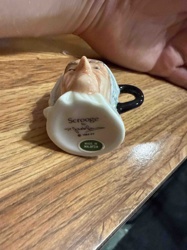
This item is a ceramic character jug or toby mug depicting the head and upper torso of an elderly man. The man is depicted with a highly detailed, wrinkled face, pronounced brows, and a substantial mustache above his mouth. He has a somber or contemplative expression. His hair, visible around the sides of his head, appears to be white or gray, suggesting age. The figure wears an olive green or khaki-colored hat, possibly a beret or a soft cap, which forms the rim of the mug. The handle of the mug originates from the back of the head, simulating an ear, and extends outwards with a curved form, decorated with orange and black striped bands near the attachment point. The coloring of the face is naturalistic, with hints of ruddy tones on the cheeks and nose, giving a lifelike appearance. The glaze appears glossy, indicative of a finished ceramic piece. While the overall condition appears good from the visible angles, specific wear, chips, or cracks cannot be fully assessed without a 360-degree view. The hand-painted details suggest an artisanal or semi-mass-produced quality typical of character jugs from the mid-20th century. Without a view of the base, manufacturing marks or signatures are not discernible. These types of mugs were popular from the 18th century onwards, but the style of this particular character suggests a post-WWII to late 20th-century production, although without maker's marks, pinpointing an exact date or manufacturer (such as Royal Doulton or similar prominent producers) is speculative. The craftsmanship is evident in the sculptural details of the face, capturing character and emotion.
AI Appraisal Report
Upon my examination of the provided images and description, this ceramic character jug, depicting an elderly man, presents as a well-crafted piece from the mid-to-late 20th century. The sculptural quality, particularly in the detailed rendering of the facial features, and the hand-painted nature of the decoration suggest a product from a reputable, though currently unidentified, manufacturer. The owner's description as 'Antique' seems plausible for a mid-century item, though it is not from the 18th or 19th century. The condition appears to be very good from the visible angles, with no apparent chips, cracks, or crazing, which is a significant factor in its value.
The market for character jugs, while not at its peak of decades past, maintains a steady interest among collectors. Jugs from renowned makers like Royal Doulton command the highest prices, but well-made, characterful pieces by other factories also have value. The primary factor limiting a more precise valuation is the absence of a maker's mark. Without a signature or backstamp (e.g., Royal Doulton, Beswick, Shorter & Son), its origin remains speculative. This lack of attribution significantly impacts its price ceiling, as collectors prioritize documented pieces.
For a full authentication, a physical examination is essential to inspect the base for any impressed or printed marks, to feel for repairs under a blacklight, and to assess the true quality of the glaze and body. Without this, I cannot definitively attribute it to a specific maker or confirm its authenticity beyond what can be visually discerned. Comparable, unsigned character jugs of this quality and period typically sell in the secondary market observed.