These notes were written by the person who submitted this item. Appraiser.AI has not verified them, and the AI's identification and estimate may rely on them.
AI Estimated Value
Not an official valuation
$800-1,200
AI estimate as of November 28, 2025 · verify with a professional before acting
AI-Generated · Verify before acting
Everything on this page is generated by AI for informational purposes only. AI can make mistakes — the AI may misidentify items or misattribute them (artist, maker, brand, designer, origin, era). This is not an official valuation and should not be used for insurance, sale, tax, estate, legal, or lending purposes — or any decision requiring a certified appraisal. It is not an authoritative claim about any person, brand, or rights holder — do not share or rely on it as a factual statement about a third party. Always consult qualified professionals before making financial decisions.
This analysis also relies on unverified notes provided by the user, which may be incomplete or inaccurate and could affect the result.
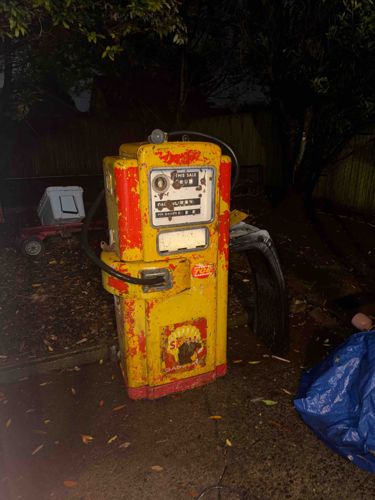
This is a vintage Shell gas pump, likely dating from the 1930s to 1950s, based on its design and the additional context of '1934 gas pump'. The pump features a tall, rectangular body with an upper display section. Its primary color scheme is yellow and red, characteristic of Shell branding during that era. The yellow paint serves as the main body color, with vertical red panels or stripes on the sides of the display unit and a red base. The paint is heavily chipped and faded, revealing underlying metal and extensive surface rust, indicating significant outdoor exposure and age. The display area, which would typically show 'THIS SALE' and 'GALLONS' along with price per gallon, appears to have white or light-colored numerical indicators, though these are severely weathered and difficult to read completely. A black hose, presumably for dispensing fuel, is visible draped around the side with a nozzle head indistinctly positioned near the base. A prominent circular Shell logo, depicted as a scallop shell in yellow and red, is visible on the lower front section of the pump, though it is also heavily worn and faded. Another smaller circular logo, possibly 'FLEXI-HOSE' or similar text, is present on the side of the display unit. The overall condition suggests it is unrestored, retaining its original weathered patina. This item would be considered a significant piece of automobilia or petroliana, highly sought after by collectors for restoration or as a decorative display.
AI Appraisal Report
Based on my visual examination of the provided image, I assess this vintage Shell gas pump, reported to be from 1934, as a significant piece of petroliana. Its design, characterized by the tall rectangular body, upper display section, and classic yellow and red Shell branding, is consistent with pumps manufactured in the 1930s to 1950s. The prominent scallop shell logo, though faded, reinforces its Shell identity. The presence of a 'FLEXI-HOSE' or similar smaller logo further aligns with period-accurate details.
The pump's condition is heavily unrestored, displaying extensive paint chipping, fading, and significant surface rust. This 'barn find' patina, while not indicative of structural integrity without physical inspection, is often desirable to collectors seeking original pieces for restoration projects or as decorative industrial art. The numerical indicators on the display are severely weathered, making them unreadable from the image alone. The black hose and nozzle are present but their condition and originality are difficult to ascertain.
Market conditions for unrestored vintage gas pumps of this era are strong, especially for iconic brands like Shell. Comparables for unrestored, but complete, pumps in similar condition typically range from $700 to $1,500, with Shell pumps often commanding the higher end due to brand recognition. Demand is consistent among automobilia and petroliana collectors. Rarity is moderate; while not exceptionally rare, a complete, unrestored pump from the 1930s in this condition is not commonplace.
Factors impacting value include the brand, apparent completeness, and the desirable unrestored patina. The potential for a high-value restoration project adds to its appeal. However, without in-person examination, I cannot definitively verify the internal components' condition, the extent of structural damage from rust, or whether this specific pump is indeed from 1934 as stated. Full authenticity and precise dating would benefit from examining serial numbers, manufacturer plates, and researching model-specific features. Without physical inspection, I must state these are limitations to a conclusive authenticity and valuation.