These notes were written by the person who submitted this item. Appraiser.AI has not verified them, and the AI's identification and estimate may rely on them.
AI Estimated Value
Not an official valuation
$75-125
AI estimate as of July 13, 2025 · verify with a professional before acting
AI-Generated · Verify before acting
Everything on this page is generated by AI for informational purposes only. AI can make mistakes — the AI may misidentify items or misattribute them (artist, maker, brand, designer, origin, era). This is not an official valuation and should not be used for insurance, sale, tax, estate, legal, or lending purposes — or any decision requiring a certified appraisal. It is not an authoritative claim about any person, brand, or rights holder — do not share or rely on it as a factual statement about a third party. Always consult qualified professionals before making financial decisions.
This analysis also relies on unverified notes provided by the user, which may be incomplete or inaccurate and could affect the result.
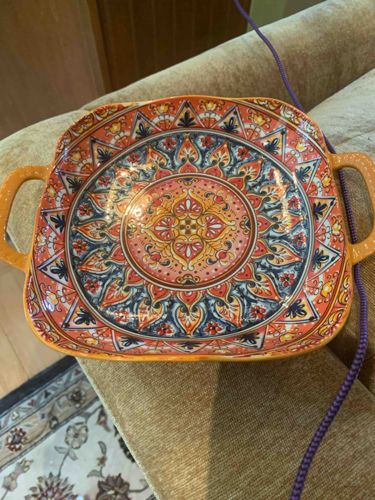
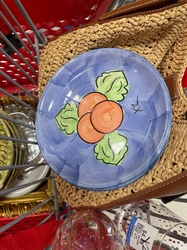
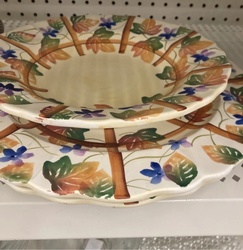
This item is a square-shaped, handled ceramic serving dish or tray, characterized by its vibrant, multi-colored hand-painted design. The primary colors in the pattern are various shades of red, orange, blue, yellow, and white, creating a rich, intricate mosaic-like or mandala pattern that covers the entire interior surface. The central motif is a detailed rosette-like design in yellow, orange, and red, encircled by concentric bands of stylized floral and geometric elements. The outermost band features fan-like or palmette shapes in blue and red against an orange background. The rim is slightly raised, and the exterior of the dish, including the two integrated handles, appears to be a solid bright orange with visible speckles, possibly intentionally textured or an indication of the ceramic glaze. The handles are semicircular and sturdy, suggesting they are functional for carrying. The dimensions are not precisely discernible from the image, but it appears to be a medium-sized dish, suitable for serving side dishes or appetizers. There are no obvious signs of significant damage such as chips or cracks visible on the surface, and the glaze appears to be intact and glossy, indicating good overall condition. The painting style suggests influence from traditional Mediterranean or Majolica ceramics, known for their bold colors and intricate patterns. The craftsmanship appears to be of good quality, with clear delineation of the painted elements, although some slight irregularities inherent to hand-painted items may be present upon closer inspection. The speckled finish on the handles and exterior adds a rustic or artisanal touch. Without a clear maker's mark, the exact age is difficult to pinpoint, but its style suggests it could be a modern piece inspired by traditional designs or a vintage item from the mid to late 20th century.
AI Appraisal Report
Upon visual examination of the Hand-Painted Ceramic Serving Dish with Handles, I assess its condition to be excellent. The vibrant, multi-colored hand-painted design on the interior appears intact and glossy, with no visible chips, cracks, or significant wear. The exterior’s bright orange with speckles also appears well-preserved. The craftsmanship is commendable, with clear delineation of the intricate rosette and geometric patterns, suggesting a skilled hand. This piece strongly evokes Mediterranean or Majolica ceramic traditions, known for their bold colors and elaborate designs.
In terms of market conditions, similar hand-painted ceramic serving dishes, particularly those with an artisanal or vintage appeal, typically find a steady demand. Comparables from contemporary artisans or established studios specializing in folk art or Mediterranean-inspired ceramics range from $60 to $150, depending on size, intricacy, and brand recognition. While not inherently rare as an art form, a unique, well-executed design like this adds to its desirability. The primary factors impacting value are its excellent condition, the detailed hand-painting, and its aesthetic appeal. Without a visible maker's mark or provenance documents, its exact authenticity, age, and artisan attribution cannot be definitively confirmed. An in-person examination would allow for closer inspection for minute flaws, material analysis (e.g., clay type, glaze composition), and the potential discovery of faint underside marks. Provenance documentation (e.g., purchase receipts, artist's signature) would significantly enhance its value by establishing its origin and uniqueness. However, based on the provided visual and textual information, it presents as a charming and functional decorative item.