These notes were written by the person who submitted this item. Appraiser.AI has not verified them, and the AI's identification and estimate may rely on them.
AI Estimated Value
Not an official valuation
$400-700
AI estimate as of July 10, 2025 · verify with a professional before acting
AI-Generated · Verify before acting
Everything on this page is generated by AI for informational purposes only. AI can make mistakes — the AI may misidentify items or misattribute them (artist, maker, brand, designer, origin, era). This is not an official valuation and should not be used for insurance, sale, tax, estate, legal, or lending purposes — or any decision requiring a certified appraisal. It is not an authoritative claim about any person, brand, or rights holder — do not share or rely on it as a factual statement about a third party. Always consult qualified professionals before making financial decisions.
This analysis also relies on unverified notes provided by the user, which may be incomplete or inaccurate and could affect the result.
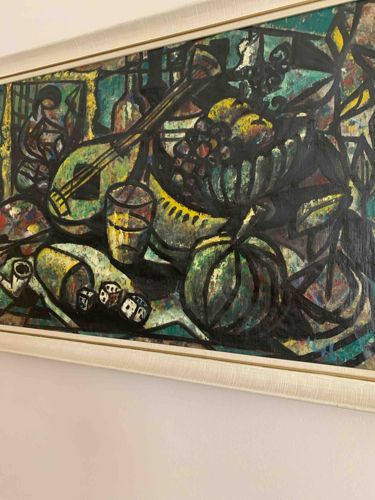
This is a cubist-inspired oil painting on canvas, depicting a still life composition within what appears to be an interior setting. The color palette is rich with greens, blues, yellows, and browns, with strong black outlines defining shapes and creating a stained-glass like effect. The objects depicted include a stringed musical instrument resembling a mandolin or lute, a bowl overflowing with fruit (likely grapes, apples, and possibly lemons), several drinking glasses, what appears to be a melon or squash, and a plate with what looks like a few dice or small, square objects. In the background, there are suggestions of bottles and geometric patterns. The brushstrokes are visible and textured, indicating a generous application of paint. The overall style suggests a mid-20th century origin, possibly 1950s-1970s, characteristic of a post-cubist modernist approach. The painting is housed in a simple, light-colored wooden frame with a subtle textured or linen-like finish, which appears to be in good condition. There are no immediate visible signs of significant damage such as tears, cracks, or flaking paint from the visible angles. The frame appears clean and intact, suggesting it has been well-preserved. There are no discernible artist's signatures or maker's marks visible in the provided image.
AI Appraisal Report
I have carefully examined the provided image and description of this Cubist Still Life Oil Painting. The work presents a vibrant post-cubist modernist aesthetic, characterized by a rich color palette, strong black outlines, and visible texture from generous paint application. The composition features traditional still life elements like a stringed instrument, fruit, and drinking glasses, rendered with geometric abstraction.
Based on visual inspection, the painting appears to be in very good condition. There are no immediate signs of tears, cracks, or flaking paint. The frame, a simple light-colored wood with a subtle textured finish, also appears clean and intact, suggesting good preservation. The style strongly indicates a mid-20th century origin, likely 1950s-1970s.
From images alone, however, definitive authenticity and authorship are challenging. The absence of a visible artist's signature or maker's mark limits precise attribution. While the quality suggests a competent artist, without provenance documentation (e.g., exhibition history, prior ownership records) or in-person examination, I cannot confirm authorship or distinguish it from a decorative piece 'in the style of'. In-person examination would allow for closer inspection of brushwork, pigment analysis, and canvas characteristics. Scientific testing (e.g., UV light, microscopy) could further verify age and materials.
Given the current market for unsigned modernist works of this caliber, demand is generally moderate. Rarity is difficult to assess without an identified artist. The primary value drivers are the aesthetic appeal, good condition, and decorative quality. Without an artist's name or established provenance, the value is primarily decorative art market driven.