AI estimate as of August 7, 2025 · verify with a professional before acting
AI-Generated · Verify before acting
Everything on this page is generated by AI for informational purposes only. AI can make mistakes — the AI may misidentify items or misattribute them (artist, maker, brand, designer, origin, era). This is not an official valuation and should not be used for insurance, sale, tax, estate, legal, or lending purposes — or any decision requiring a certified appraisal. It is not an authoritative claim about any person, brand, or rights holder — do not share or rely on it as a factual statement about a third party. Always consult qualified professionals before making financial decisions.
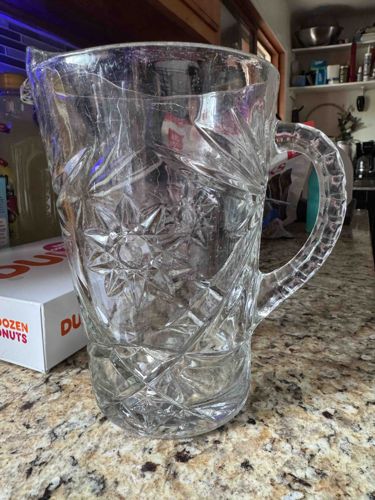
This is a clear glass pitcher, likely made of pressed glass, featuring an ornate and textured exterior design. The pitcher is of a substantial size, appearing to hold at least 1.5 to 2 liters. Its primary material is clear, transparent glass, allowing for visibility of its contents. The design details are a notable feature, primarily composed of a large, starburst or pinwheel pattern repeated around the upper body, transitioning into a diamond-cut or cross-hatch pattern towards the base. This pressed glass technique creates a highly faceted surface, which would refract light beautifully, giving the impression of cut crystal, though it's typically more affordable to produce. The handle is integrated seamlessly into the design, also featuring a textured, ribbed, or faceted surface for improved grip and aesthetic continuity. The rim of the pitcher appears to have a slight pour spout, common for beverage pitchers, and one side of the rim exhibits a visible chip or breakage, indicating wear or damage from use. There are no visible maker's marks or signatures in the provided images, which is common for mass-produced pressed glass items. Based on the style and common manufacturing techniques for this kind of glassware, it likely dates from the mid-20th century, possibly from the 1940s to 1970s, a period when patterned pressed glass was very popular for utilitarian and decorative household items. The overall condition, aside from the visible chip, seems good, with typical wear marks or light scratches expected from an item of its age and usage. The craftsmanship is indicative of standard industrial glass production rather than bespoke artisan work.
AI Appraisal Report
Upon visual examination of the provided image, I assess this clear pressed glass pitcher with a starburst and diamond pattern. The condition, while generally good for its age, is negatively impacted by a visible chip or breakage on the rim, which is a significant detractor. Authenticity is based on the recognizable pressed glass manufacturing techniques and stylistic elements common to mid-20th-century American production (roughly 1940s-1970s). Without maker's marks, definitive attribution to a specific factory (e.g., Anchor Hocking, Federal Glass, Hazel-Atlas) is impossible from images alone.
Market conditions for utilitarian pressed glass items like this pitcher are currently modest. While vintage glassware has a collector base, common patterns and non-rare forms do not command high prices. Comparables in similar patterns and condition typically sell for modest amounts. Demand is primarily from casual collectors or individuals seeking vintage decor. Rarity is low; this type of glassware was mass-produced. The primary factor significantly impacting value is the chip on the rim; an undamaged piece would fetch more. Secondary factors include the lack of unique features or maker attribution.
Limitations in authenticity verification from images alone are substantial. I cannot confirm the exact manufacturing period, the presence of subtle defects, or the weight and feel. A full in-person examination would allow for tactile inspection of the glass quality, closer scrutiny of the chip, and a more thorough search for any faint maker's marks or mold lines. Provenance documentation, such as original sales receipts or family history, could add to its story but not its inherent value. Scientific testing is not typically applied to mass-produced pressed glass of this nature.