AI Appraisal Estimate

AI-generated estimates · not official valuations

From the user

What was submitted

Photo and notes provided by the user — not generated by AI

Submitted item photo
Submitted photo · June 23, 2026

User's notes

No additional notes provided.

AI analysis below

AI appraisal

AI analysis & estimate

AI-Generated · Verify before acting

Everything below is generated by AI for informational purposes only. AI can make mistakes — the AI may misidentify items or misattribute them (artist, maker, brand, designer, origin, era). This is not an official valuation and should not be used for insurance, sale, tax, estate, legal, or lending purposes — or any decision requiring a certified appraisal. It is not an authoritative claim about any person, brand, or rights holder — do not share or rely on it as a factual statement about a third party. Always consult qualified professionals before making financial decisions.

Read the full disclaimer

AI Identification

·Not independently authenticated·Verify before acting

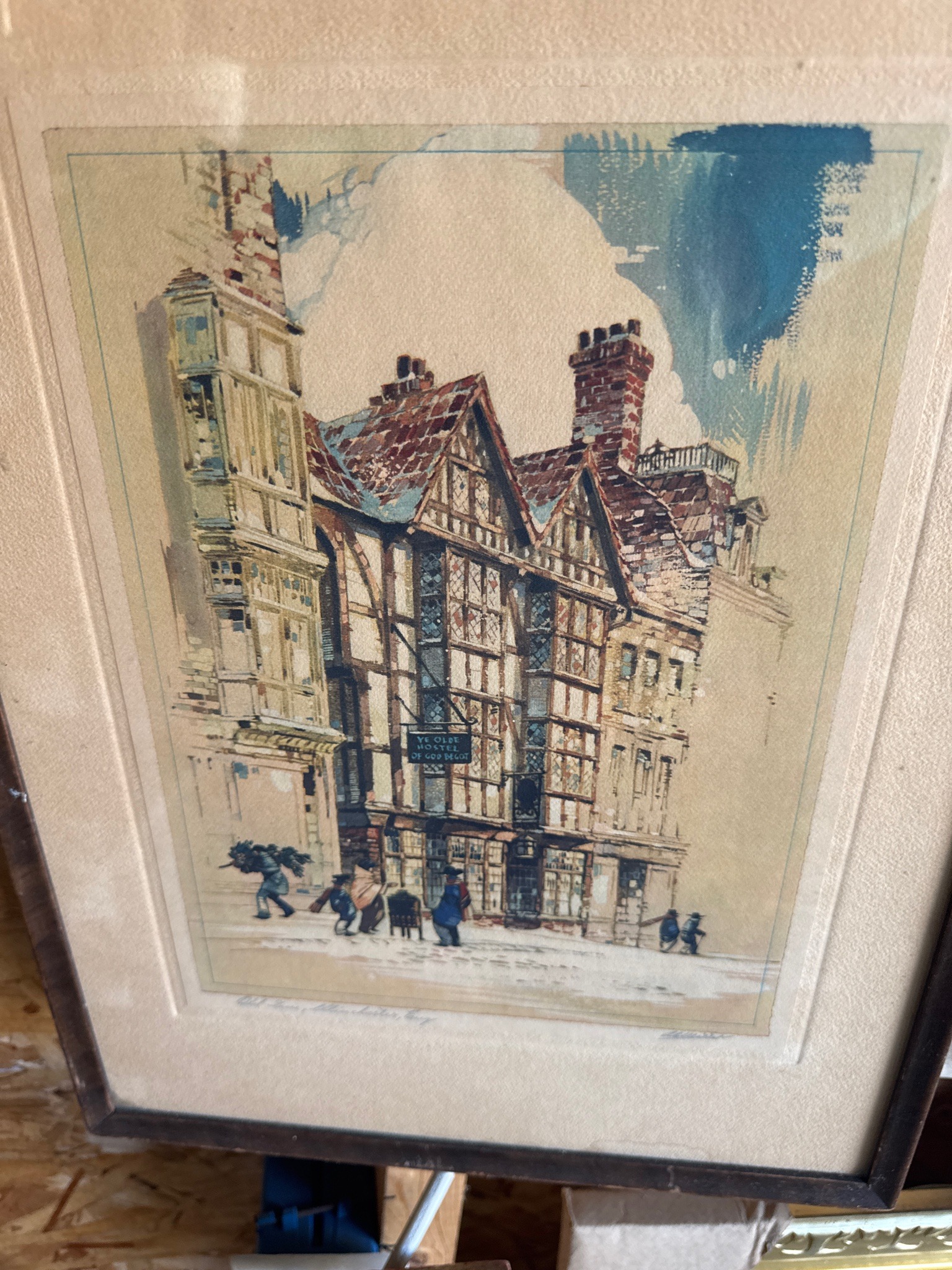
Early-20th-century style architectural etching in the manner of Axel Haig

Art Prints

AI Estimated Value

·Not an official valuation·Verify before acting

$75 - $150

As of June 23, 2026

AI Item Analysis

·AI can make mistakes·Verify before acting
This item appears to be an architectural color etching or lithographic print depicting a historic timber-framed building. The scene features 'Ye Olde Hostel of God Begot,' an actual historic site in Winchester, England, as indicated by the legible signage on the building's facade. The artwork shows figures in period-consistent clothing in the foreground, suggesting a stylized historical recreation. The color palette is dominated by ochres, umbers, and blues, with a notable 'sky' area that appears unfinished or stylized with broad blue strokes at the top right. Below the image plate, there are handwritten graphite inscriptions that appear to be a title on the left and a signature on the right; however, these are too faint to be read with any degree of certainty from the photograph. The print is housed behind a textured mat and a dark wood frame. Condition-wise, the paper displays visible foxing (brown age spots) and general yellowing, which is consistent with early-to-mid-20th-century paper stock. The framing shows minor scuffing. Without physical inspection, the medium cannot be confirmed, but it is stylistically consistent with topographical prints produced in England during the late 19th or early 20th centuries.

AI Appraisal Report

·AI can make mistakes·Verify before acting
I have examined the image provided of the architectural etching depicting 'Ye Olde Hostel of God Begot'. From what I can see, this item appears to be an early-20th-century topographical print, likely an etching or lithograph, executed in a style reminiscent of Axel Haig. While the work bears a signature and title in graphite, these are too faint for me to identify or verify from a photograph. The value estimate is predicated on the hypothesis that this is a period print by a skilled but perhaps lesser-known topographical artist. Based on the visible brown spotting, or ‘foxing’, and the overall yellowing of the paper, the piece shows clear signs of age consistent with mid-range architectural works of its era. This condition notably impacts the value, as restoration of foxed paper can be costly. I cannot verify from a photo the specific medium or whether the color was applied by hand or via a printed plate. This distinction is critical, as a hand-colored etching generally commands more interest than a mechanical reproduction. In the current market, decorative architectural scenes of English heritage sites maintain steady but modest demand. To confirm authorship and value, an in-person examination would be necessary to inspect the paper's watermark, the plate mark's depth, and the ink's texture. If this item were found to be a more modern mass-produced photomechanical reproduction rather than a period etching, the value would likely drop below $30. Conversely, if documentation or physical inspection attributed the work to a highly collected printmaker of the period, the value could exceed the current estimate.

Get your items appraised

Instant estimates of your treasures with AI-powered appraisals

Browse More Appraisals