AI estimate as of December 16, 2025 · verify with a professional before acting
AI-Generated · Verify before acting
Everything on this page is generated by AI for informational purposes only. AI can make mistakes — the AI may misidentify items or misattribute them (artist, maker, brand, designer, origin, era). This is not an official valuation and should not be used for insurance, sale, tax, estate, legal, or lending purposes — or any decision requiring a certified appraisal. It is not an authoritative claim about any person, brand, or rights holder — do not share or rely on it as a factual statement about a third party. Always consult qualified professionals before making financial decisions.
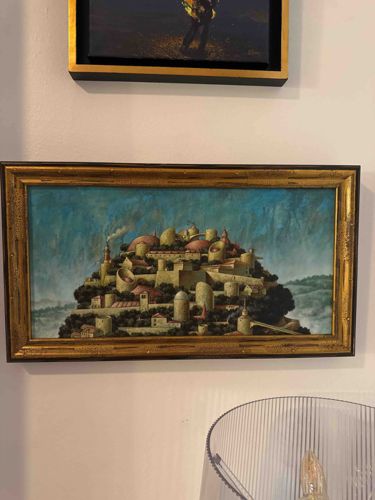
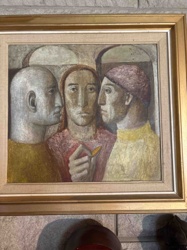
This item is an oil or acrylic painting depicting a fantastical, architectural landscape of a densely packed hilltop town. The painting is rectangular, oriented horizontally, and is housed within a substantial gold-toned wooden frame. The frame features intricate carved or molded detailing, suggesting a traditional or ornate aesthetic. The artwork itself presents a whimsical and somewhat surreal interpretation of a medieval-inspired settlement, with numerous rounded domes, conical structures, and rectangular buildings clustered together on a prominent hill. The color palette of the town primarily consists of earthy tones – various shades of beige, tan, and light brown for the buildings, interspersed with dark green foliage. Several small red-orange domes or roofs add splashes of color. Above the town, the sky is rendered in a textured blue, transitioning from a lighter, almost greenish-blue near the horizon to a darker, more saturated blue higher up. Wisps of white smoke emanate from some of the structures, adding to the imagined activity within the town. The background on either side of the hill shows muted, rolling landscapes in soft greens and blues, contributing to the depth of field. The brushstrokes appear visible, hinting at a painterly technique. No visible artist's signature or specific markings are discernible from the provided image. The overall condition of the painting appears good, with no obvious signs of cracking, flaking, or significant damage. The frame, while ornate, also seems well-preserved. Given the detailed architectural elements and the fantastical composition, the piece could fall into a naive, folk art, or surrealist style, possibly dating from the mid-20th century onwards. The craftsmanship lies in the detailed rendering of the many structures and the cohesive, imaginative scene.
AI Appraisal Report
Based on my visual examination of the provided image, this Surreal Landscape Painting of a Hilltop Town is a charming and well-executed piece. The condition appears to be very good; I observe no obvious cracking, flaking, or significant damage to the paint surface. The ornate gold-toned frame also seems well-preserved. Authenticity, based solely on an image, is difficult to ascertain fully. There is no visible artist's signature, which limits definitive attribution without further inspection.
Market conditions for folk art, naive art, and surreal architectural landscapes can be quite variable, largely depending on the artist's recognition and provenance. Given the absence of a signature, this piece would likely be considered an 'unsigned work' in the current market. Comparables for unsigned, detailed fantastical landscapes like this, especially those with visible painterly techniques, typically fall into the mid-range for decorative art. Demand for such whimsical pieces is generally steady, appealing to collectors of unique or folk-art inspired works. Rarity is moderate; while the subject matter itself isn't unique, the specific rendering and detailing make it stand out.
Factors significantly impacting value include the detailed craftsmanship, the pleasing aesthetic, and its good condition. The ornate frame also adds to its presentation value. However, the lack of an identifiable artist or provenance is the primary limiting factor in achieving a higher valuation.
For full authentication and a more precise valuation, an in-person examination would be crucial to assess the paint media (oil vs. acrylic), canvas or support type, and detect any potential hidden signatures or markings. Scientific testing, such as pigment analysis, could help date the work more accurately. Documentation of its history of ownership (provenance) would also be highly beneficial.