AI estimate as of October 4, 2025 · verify with a professional before acting
AI-Generated · Verify before acting
Everything on this page is generated by AI for informational purposes only. AI can make mistakes — the AI may misidentify items or misattribute them (artist, maker, brand, designer, origin, era). This is not an official valuation and should not be used for insurance, sale, tax, estate, legal, or lending purposes — or any decision requiring a certified appraisal. It is not an authoritative claim about any person, brand, or rights holder — do not share or rely on it as a factual statement about a third party. Always consult qualified professionals before making financial decisions.
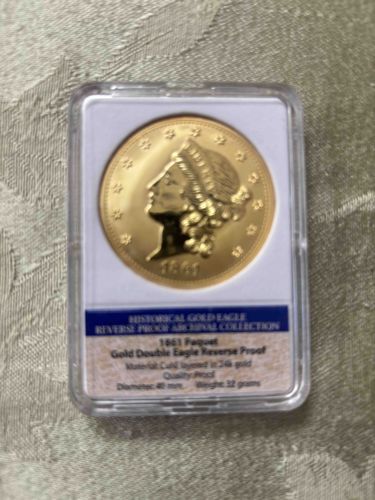
The item is a gold coin, likely a commemorative or replica piece, presented in a clear, rectangular protective plastic slab. The coin itself is circular, featuring a distinct golden color with a polished, reflective finish, characteristic of a 'proof' strike. The obverse side, which is visible, displays a left-facing bust of a female figure, adorned with a detailed headdress. The year '1861' is clearly visible below the bust. Surrounding the central image are a series of small, five-pointed stars. The coin is encased in a transparent plastic holder, which has a white inner frame around the coin. At the bottom of the holder, there is a blue and white label with black text. The blue band at the top of the label reads "HISTORICAL GOLD EAGLE REVERSE PROOF ARCHIVAL COLLECTION". Below this, in white text, it states "1861 Paquet Gold Double Eagle Reverse Proof". Further details on the label, though partially obscured and difficult to read completely from the image, indicate 'Material: Gold layered in 24k gold' (OCR suggests 'Material Gold layered in 24k gold'), 'Quality: Proof', 'Diameter: 40 mm', and 'Weight: 32 grams'. The meticulous detail on the bust, stars, and lettering suggests high-quality craftsmanship, common for proof coins. There are no visible signs of wear, scratches, or damage on the coin or its protective casing, suggesting it has been well-preserved or is relatively new. The bright, unblemished gold surface further supports its 'proof' designation, implying a high-strike quality and special finish. This item appears to be an archival or collectible piece, possibly a modern strike honoring an historical coin, rather than an original circulated currency.
AI Appraisal Report
I have examined the image of the '1861 Paquet Gold Double Eagle Reverse Proof Archive Coin'. Visually, the item presents as a modern commemorative piece, not an original 1861 U.S. Double Eagle. The label clearly states "Gold layered in 24k gold" and identifies it as part of a "Historical Gold Eagle Reverse Proof Archival Collection," confirming it is a plated replica or tribute and not a solid gold coin of historical mintage. The condition appears to be excellent, consistent with a 'proof' finish and protected within its original slab, showing no visible wear, scratches, or damage. This pristine state is expected for a modern archive piece. The craftsmanship, as far as can be gleaned from the image, appears high quality, designed to mimic the aesthetic of a genuine proof coin.
Market conditions for such gold-layered replicas vary significantly from genuine historical coinage. These items are typically sold as collectibles or decorative pieces rather than as investments in precious metals or rare coins. Demand is fueled by their aesthetic appeal and the commemorative aspect rather than numismatic value. Comparables would be other gold-layered or tribute coins from similar 'archive' or 'collection' series. Rarity is low, as these are mass-produced. The primary factor impacting value is the 'gold layered' designation, which means its intrinsic metal value is negligible. Its value lies entirely in its collectible nature as a commemorative item.
Authenticity verification for this item would focus on confirming it is indeed a gold-layered replica as stated, rather than an original. An in-person examination would allow for tactile inspection and verification of weight and dimensions against specifications, though the label provides these. Scientific testing (e.g., XRF analysis) would be needed to confirm the gold layering and composition, if there were any doubt from the labeling. Provenance documentation would typically be a certificate of authenticity from the producer of the archival collection. Without physical examination, I can only rely on the information presented on the protective slab's label regarding its composition and nature.