AI Appraisal Estimate

AI-generated estimates · not official valuations

From the user

What was submitted

Photo and notes provided by the user — not generated by AI

Submitted item photo
Submitted photo · May 19, 2026

User's notes

No additional notes provided.

AI analysis below

AI appraisal

AI analysis & estimate

AI-Generated · Verify before acting

Everything below is generated by AI for informational purposes only. AI can make mistakes — the AI may misidentify items or misattribute them (artist, maker, brand, designer, origin, era). This is not an official valuation and should not be used for insurance, sale, tax, estate, legal, or lending purposes — or any decision requiring a certified appraisal. It is not an authoritative claim about any person, brand, or rights holder — do not share or rely on it as a factual statement about a third party. Always consult qualified professionals before making financial decisions.

Read the full disclaimer

AI Identification

·Not independently authenticated·Verify before acting

Vintage Neoclassical Alabaster and Gilt Brass Wall Sconce

Antique Lighting & Home Decor

AI Estimated Value

·Not an official valuation·Verify before acting

$250 - $450

As of May 19, 2026

AI Item Analysis

·AI can make mistakes·Verify before acting
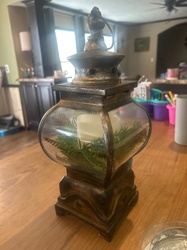
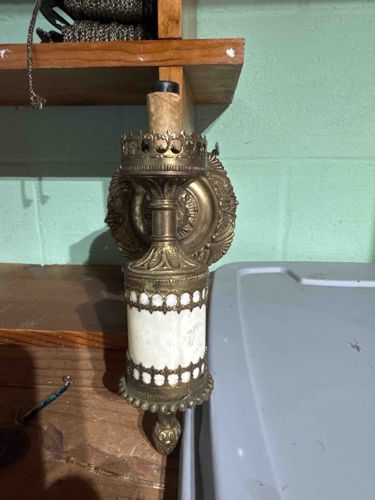
This is a vintage wall-mounted electric sconce designed in the Neoclassical style, likely dating from the mid-20th century. The light fixture features a central cylindrical section made of carved white alabaster, which displays natural gray veining. This stone cylinder is encased in ornate gilt brass or bronze-finished metal galleries with a repeating scalloped lace pattern. The metalwork shows a significant aged patina with darkening and green oxidation visible in the crevices. The fixture consists of a round decorative wall plate with cast foliate motifs, an arched support arm, and a vertical torchère-style body terminating in a pinecone or acorn-shaped finial at the base. At the top, a fluted metal neck leads to a pierced gallery that would have originally held a glass shade. Inside, a cardboard candle-cover sheath surrounds a modern electrical socket. The overall construction suggests a mass-produced but high-quality decorative piece from the 1940s-1960s, designed to mimic European antiques. Condition notes include surface dust, tarnishing of the metal finish, and minor pitting, though the alabaster appears structurally sound without visible cracks.
AI Appraisal Report

·AI can make mistakes·Verify before acting
I have conducted a visual inspection of the Neoclassical Alabaster and Gilt Brass Wall Sconce. The piece exhibits the hallmarks of high-quality mid-century revival lighting, specifically the torchère form popular between 1940 and 1960. The use of genuine Italian alabaster with natural veining suggests a step above standard mass-production, though the cardboard socket sleeve confirms its mid-century electrical origins rather than a 19th-century antique provenance. The condition is fair to good. While the alabaster is remarkably intact with no visible hairline fractures—a common failure point—the metal components show heavy oxidation and verdigris. While some collectors value this patina, it may necessitate professional cleaning to appeal to a broader decorative market. The absence of the original glass shade (likely a flame or frosted globe) slightly depresses the current value. Market demand for Neoclassical lighting remains steady among interior designers, though solitary sconces are generally less desirable than matched pairs. Comparable sales of single sconces of this quality typically range from $250 to $450 depending on the retail venue. Limitations of Image-Based Appraisal: This valuation is based solely on visual inspection. Without a physical examination, I cannot verify if the alabaster is genuine stone or a high-quality resin 'alabastrite,' nor can I test the integrity of the internal wiring. A full authentication would require inspecting the casting marks behind the wall plate to identify the foundry (e.g., Stiffel or a European maker) and confirming the stone's translucency under UV light. Provenance documentation or original manufacturer catalogs would be needed to confirm if this is an authentic European import or a domestic revival piece.

Get your items appraised

Instant estimates of your treasures with AI-powered appraisals

Browse More Appraisals