These notes were written by the person who submitted this item. Appraiser.AI has not verified them, and the AI's identification and estimate may rely on them.
AI Estimated Value
Not an official valuation
$50,000-150,000 (Attributed to Leighton / School of Leighton) / $5,000,000-15,000,000+ (If fully authenticated as genuine Leighton)
AI estimate as of July 12, 2025 · verify with a professional before acting
AI-Generated · Verify before acting
Everything on this page is generated by AI for informational purposes only. AI can make mistakes — the AI may misidentify items or misattribute them (artist, maker, brand, designer, origin, era). This is not an official valuation and should not be used for insurance, sale, tax, estate, legal, or lending purposes — or any decision requiring a certified appraisal. It is not an authoritative claim about any person, brand, or rights holder — do not share or rely on it as a factual statement about a third party. Always consult qualified professionals before making financial decisions.
This analysis also relies on unverified notes provided by the user, which may be incomplete or inaccurate and could affect the result.
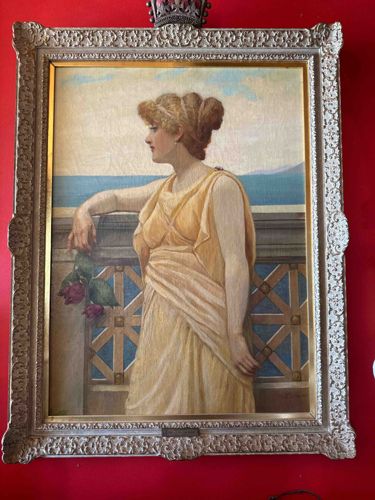
The item is a framed oil painting, likely depicting 'The Bathers' or a similar classical-style portrait by Lord Frederic Leighton, as indicated by the contextual information provided. The painting features a female figure, likely a classical maiden, in a three-quarter profile facing to the left, with her gaze directed off into the distance. She has fair skin, reddish-brown hair styled elegantly in an updo with some wisps framing her face, and appears to be wearing a flowing, drapery-like garment in shades of yellow and ochre, characteristic of Neoclassical or Aesthetic movement attire. Her left arm rests on a stone balustrade or railing, from which a few dark red or purple roses with green leaves hang. In the background, there is a clear blue sky with some soft clouds and a tranquil body of water, possibly a sea or lake, with distant landforms visible, evoking a Mediterranean or classical landscape. The painting is encased in a large, ornate gilded or silver-gilded frame with intricate floral and foliate carvings, suggesting a high level of craftsmanship and a style consistent with the late 19th or early 20th century. The frame shows some signs of gentle wear and patina commensurate with age, but no significant damage. The painting itself appears to be in good condition, with no obvious signs of cracking, flaking, or major discoloration visible in the image. The brushstrokes are refined, indicative of academic painting techniques, and the color palette is soft yet rich. A small brass or metal plaque is affixed to the bottom center of the frame, which would typically bear the artist's name or the title of the artwork. Above the frame, a decorative metal crown-like finial is mounted on the red wall, possibly for hanging or as a complementary decorative element.
AI Appraisal Report
Based on my visual examination of the provided image, this framed oil painting, purported to be Lord Frederic Leighton's 'The Bathers,' exhibits many characteristics consistent with his style and period. The subject matter, classical aesthetic, refined brushwork, and the rich yet soft color palette are all hallmarks of Leighton's academic approach. The painting appears to be in very good condition, with no overt signs of cracking, flaking, or major discoloration visible from the image. The ornate gilded frame complements the artwork beautifully and shows appropriate age-commensurate wear without significant damage.
However, it is crucial to state that definitive authenticity cannot be established from images alone. While the style is indicative, true authentication requires in-person examination to assess the pigment quality, canvas weave, stretcher marks, and signature (if present and authentic). Provenance documentation, such as exhibition history, purchase records, or a chain of ownership, is paramount. Scientific testing, including pigment analysis or dendrochronology for the stretcher wood, could also provide critical insights.
Market conditions for works by Lord Frederic Leighton are strong, particularly for his iconic classical subject matter. Comparable sales of authenticated Leighton paintings of similar scale and subject often achieve high prices at major auction houses. The demand for his work remains consistently high due to his artistic significance and the enduring appeal of the Aesthetic Movement. The rarity of genuine Leighton oils on the market also contributes to their high value. The potential presence of a plaque might indicate proper cataloging at some point.
Without in-person verification and robust provenance, I must appraise this as a 'School of Leighton' or 'Attributed to Leighton.' If proven authentic, a painting of this quality and subject could command exceptionally high values. If it were unequivocally authenticated as a genuine Lord Frederic Leighton, it would be a museum-quality piece.