AI estimate as of June 27, 2025 · verify with a professional before acting
AI-Generated · Verify before acting
Everything on this page is generated by AI for informational purposes only. AI can make mistakes — the AI may misidentify items or misattribute them (artist, maker, brand, designer, origin, era). This is not an official valuation and should not be used for insurance, sale, tax, estate, legal, or lending purposes — or any decision requiring a certified appraisal. It is not an authoritative claim about any person, brand, or rights holder — do not share or rely on it as a factual statement about a third party. Always consult qualified professionals before making financial decisions.
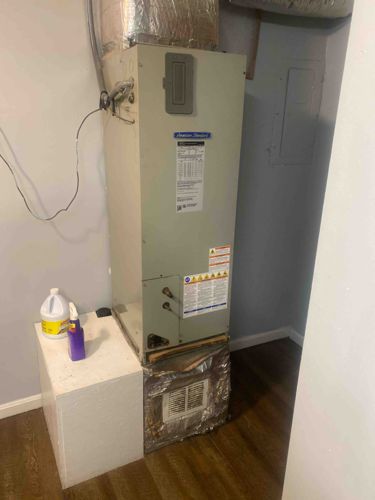
This is a vertical American Standard air handler unit, a central component of a residential heating and air conditioning system. The unit stands tall and slender, encased in sturdy, light gray or beige sheet metal. Its rectangular form is characteristic of modern HVAC indoor units, estimated to be approximately 5 to 6 feet in height, about 2 feet wide, and 2 feet deep. Prominently displayed on the front is a blue 'American Standard' manufacturer's label, indicating its brand. Below the branding, various informational and warning labels with schematics and safety instructions are affixed, though specific model details are not legible.
At the top, a large insulated duct connects to the unit, likely serving as the supply plenum. The insulation is silver, possibly a foil-faced fibrous material. On the lower section, a visible return air duct, partially wrapped in similar silver insulation, features a white plastic or metal grille, which is typically where the air filter is accessed or housed. An electrical service disconnect box, gray in color, is mounted near the top center of the unit. On the left side, electrical conduit and wiring are routed upwards, connecting to the building's electrical system. Two small, rounded protuberances, potentially service valves or refrigerant line connections, are visible on the lower-right side of the main casing.
The air handler rests upon a substantial, white rectangular platform, possibly a custom-built base or part of a larger system like a condensate pan or a separate return air box. Overall, the unit appears to be in good, operational condition with no significant dents, rust, or wear visible on its exterior casing. The ductwork insulation shows some minor creasing but remains intact. Its clean appearance suggests it is a relatively modern iteration, likely manufactured within the last two decades, representing standard, quality residential HVAC equipment from a reputable brand.
AI Appraisal Report
Based on my visual examination of the provided image, this American Standard vertical air handler unit appears to be in good overall external condition. The casing shows no significant dents, rust, or wear, and the insulated ductwork connections are intact. The prominent 'American Standard' branding suggests authenticity as a product from this reputable manufacturer. Visually, it appears relatively modern, likely manufactured within the last two decades.
The market for used residential HVAC components is specialized, driven by replacement needs or specific project requirements. Comparables are typically other used air handlers found on online marketplaces or through specialized HVAC salvage operations. While new air handlers can range from $800 to over $3,000, used units depreciate sharply. Demand generally exists for functional, cost-effective replacement parts, but these general air handlers are not rare items.
The primary factors impacting value here are the reputable brand and seemingly good external condition. However, crucial unknowns significantly limit a precise valuation from images alone. These include the exact age, specific model number, BTU/tonnage capacity, and, most critically, its verified operational status and internal component condition. Without confirmation that it is fully functional and leak-free, its value is significantly diminished, essentially being appraised for parts or as a speculative replacement.
For full authentication and a definitive valuation, a physical inspection is essential. This would involve locating and verifying the model and serial numbers, conducting thorough operational tests of the blower motor and internal coils, assessing the condition of the evaporator coil and control board, and determining its precise compatibility with outdoor units. Provenance documentation, such as original purchase receipts or service history, would also be invaluable.