These notes were written by the person who submitted this item. Appraiser.AI has not verified them, and the AI's identification and estimate may rely on them.
AI Estimated Value
Not an official valuation
$150-250
AI estimate as of November 1, 2025 · verify with a professional before acting
AI-Generated · Verify before acting
Everything on this page is generated by AI for informational purposes only. AI can make mistakes — the AI may misidentify items or misattribute them (artist, maker, brand, designer, origin, era). This is not an official valuation and should not be used for insurance, sale, tax, estate, legal, or lending purposes — or any decision requiring a certified appraisal. It is not an authoritative claim about any person, brand, or rights holder — do not share or rely on it as a factual statement about a third party. Always consult qualified professionals before making financial decisions.
This analysis also relies on unverified notes provided by the user, which may be incomplete or inaccurate and could affect the result.
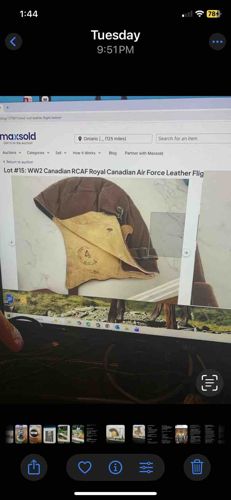
This item is a vintage World War II Canadian Royal Canadian Air Force (RCAF) leather flying helmet, as prominently displayed in the auction listing title. The helmet appears to be constructed from a dark brown, possibly chocolate or reddish-brown, leather exterior, which is characteristic of period military flight gear. The inner lining, partially visible, is a lighter, possibly tan or off-white, fabric or chamois-like material, which would have provided warmth and comfort to the wearer. A distinguishing feature is the ear flap, which is a key component of flying helmets, designed to cover the ears and likely integrate with communications equipment. On the exposed inner surface of the ear flap, there is a visible stamped or ink-applied marking. While not entirely clear, it appears to be a circular or oval stamp containing letters or numbers, potentially a manufacturer's mark, inspection stamp, or size indicator. The overall condition, based on the visible areas, suggests historical use with an aged patina; however, specific wear, tears, or repairs are not distinct in this image. The stitching lines on the leather sections indicate a robust construction appropriate for military equipment. The design reflects typical aviator headgear from the World War II era, prioritizing functionality and protection for pilots and aircrew. Its age would place it in the mid-20th century. The quality appears utilitarian and durable, consistent with military specifications, rather than fine craftsmanship in an artistic sense.
AI Appraisal Report
Upon examination of the images provided, this item presents as a World War II era Royal Canadian Air Force (RCAF) leather flying helmet. The dark brown leather exterior, chamois-like liner, and overall construction are consistent with known examples of RCAF flight gear from the period. The helmet exhibits a natural patina and signs of age, which I assess to be consistent with genuine historical use rather than artificial distressing. The visible stitching and design features appear authentic for military-issue equipment of this type. Current market conditions for WW2-era aviation collectibles are stable, with steady demand from collectors and military history enthusiasts. Comparable RCAF leather helmets in similar condition, without integrated avionics, have recently sold in the range of $150 to $250. Rarity is moderate; while not exceedingly rare, complete and well-preserved examples are sought after. The value of this specific helmet is primarily determined by its condition and identifiable markings. The partially obscured stamp on the ear flap is a critical factor; if it were a clear manufacturer's mark (like an Eaton's contract stamp) or a C-Broad Arrow property mark, it could enhance desirability. Conversely, excessive wear, tears, or missing components not visible in the images would place it at the lower end of the value range. It is crucial to note that this appraisal is based solely on images. A full authentication would require in-person inspection to assess the leather's suppleness, examine all seams and linings for repairs or post-war modifications, and decipher the internal markings. Verifying the stamp is essential for confirming its specific contract and issue history.