AI Appraisal Estimate

AI-generated estimates · not official valuations

From the user

What was submitted

Photo and notes provided by the user — not generated by AI

Submitted item photo
Submitted photo · July 20, 2026

User's notes

No additional notes provided.

AI analysis below

AI appraisal

AI analysis & estimate

AI-Generated · Verify before acting

Everything below is generated by AI for informational purposes only. AI can make mistakes — the AI may misidentify items or misattribute them (artist, maker, brand, designer, origin, era). This is not an official valuation and should not be used for insurance, sale, tax, estate, legal, or lending purposes — or any decision requiring a certified appraisal. It is not an authoritative claim about any person, brand, or rights holder — do not share or rely on it as a factual statement about a third party. Always consult qualified professionals before making financial decisions.

Read the full disclaimer

AI Identification

·Not independently authenticated·Verify before acting

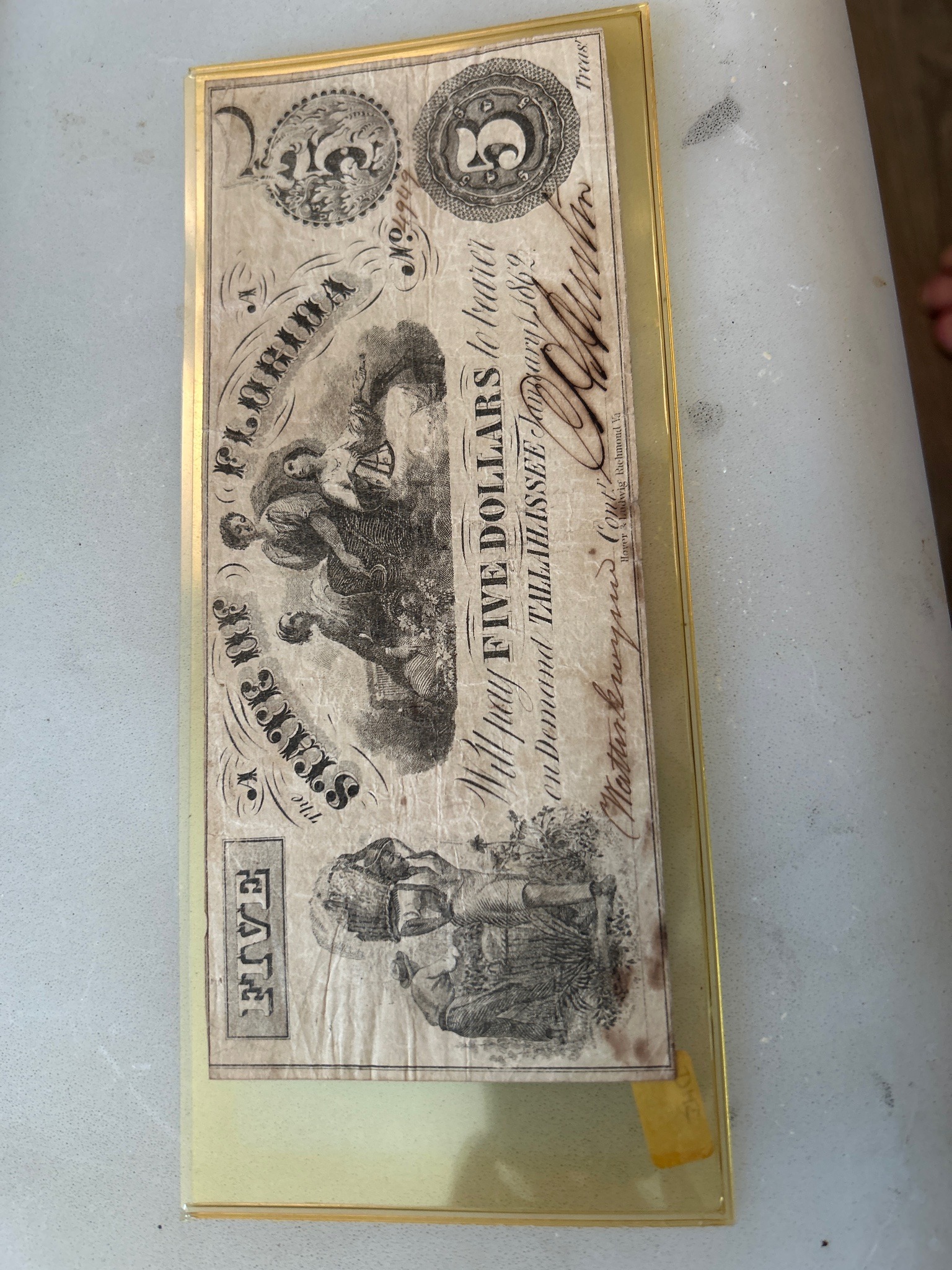
Currency note in the style of an 1862 State of Florida five-dollar bill

Paper Currency and Ephemera

AI Estimated Value

·Not an official valuation·Verify before acting

$150-$450

As of July 20, 2026

AI Item Analysis

·AI can make mistakes·Verify before acting
This item is a bank note consistent with the design of a 'State of Florida' five-dollar bill, bearing an as-marked date of 'January 1st, 1862.' The note is printed on thin, light-brown paper and features several intricate vignettes, including images of female figures and cotton harvesting. Visible text includes 'Will pay FIVE DOLLARS to bearer on Demand TALLAHASSEE,' along with the number '4949' and signatures that appear to read 'C. H. Austin' and 'John Milton.' The bottom right corner mentions 'Hoyer & Ludwig, Richmond Va.' The paper shows signs of age, including heavy creasing, minor staining, and softening of the edges. It is currently encased in a modern protective plastic sleeve with a gold-toned border. While the visual details align with Confederate-era state-issued currency, such items were frequently reproduced as souvenirs and for educational purposes in the 20th century. Without a physical inspection to verify the ink depth, paper fiber composition, and printing method (e.g., lithography versus modern offset printing), the piece is considered a hypothesis of a 19th-century note and remains unauthenticated.

AI Appraisal Report

·AI can make mistakes·Verify before acting
I have examined the digital image of this currency note, which bears characteristics consistent with an 1862 State of Florida five-dollar bill. Based on what I can see, the vignettes and signatures associated with Austin and Milton align with the design of mid-19th-century Confederate-era state issues. However, I cannot verify the paper fiber, ink depth, or printing technique from a photo. The presence of heavy creasing and edge softening is typical for age, but these features were also occasionally simulated in mid-20th-century reproductions. My valuation reflects a range for a hypothesized civil-war-era note in circulated condition. Market demand for Southern state-issued currency is generally steady among historical collectors, though pricing is highly sensitive to the specific state and rarity of the series. If this item were to be physical inspected and confirmed as a period-correct issue, it would likely command the $150-$450 range. If an in-person examination by a numismatic expert or laboratory testing determines this to be a modern souvenir or reproduction—common for this specific 1862 design—the value would drop significantly to a nominal decorative or educational value, typically under $10. To reach a more certain conclusion, an expert would need to check for the absence of modern printing patterns under magnification and verify the nature of the signatures.

Related Tags

Explore similar items and categories

Get your items appraised

Instant estimates of your treasures with AI-powered appraisals

Browse More Appraisals