AI estimate as of August 10, 2025 · verify with a professional before acting
AI-Generated · Verify before acting
Everything on this page is generated by AI for informational purposes only. AI can make mistakes — the AI may misidentify items or misattribute them (artist, maker, brand, designer, origin, era). This is not an official valuation and should not be used for insurance, sale, tax, estate, legal, or lending purposes — or any decision requiring a certified appraisal. It is not an authoritative claim about any person, brand, or rights holder — do not share or rely on it as a factual statement about a third party. Always consult qualified professionals before making financial decisions.
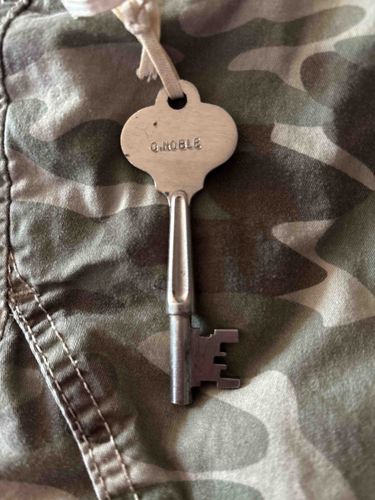
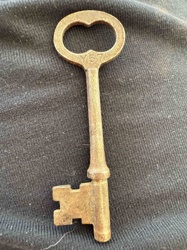
This item is an antique or vintage skeleton key, likely made of steel or a similar robust metal alloy given its metallic sheen and apparent rigidity. It features a characteristic quatrefoil or clover-shaped bow at the top, which serves as the handle and includes a circular perforation for hanging or attachment. A narrow, flat, braided cord or ribbon, light in color (possibly off-white or beige), is threaded through this hole, indicating it was perhaps part of a keychain or decorative display. The shaft of the key is solid and relatively slender, transitioning from a rounded cross-section near the bow to a more rectangular shape as it approaches the bit. The bit itself is complexly cut, featuring multiple rectangular notches and projections, which is typical of skeleton keys designed to operate warded locks.
One of the most notable features is the engraving "G. NOBLE" on the flattened surface of the bow. The letters are neatly impressed, suggesting machine stamping rather than hand-etching, which implies a manufacturing origin rather than a personalized, post-purchase engraving. The key exhibits a visible patina consistent with age and use; there are minor surface scratches, some dulling of the metal's luster, and possibly slight discoloration or darkening in crevices, though no significant rust or active corrosion is apparent. The overall condition appears stable, with no visible bending or breakage. The craftsmanship suggests a functional, durable piece, likely from the late 19th or early to mid-20th century, a period when such keys were widely used for doors, cabinets, and chests. The 'G. NOBLE' inscription might refer to a lock manufacturer, a property owner, or perhaps a hotel or building. The key’s simple yet elegant design, combined with its functional purpose and the intriguing inscription, makes it a compelling piece of historical hardware.
AI Appraisal Report
Upon examining the provided image of the G. Noble Skeleton Key, I assess its condition as good vintage/antique, showing appropriate wear for its age without significant damage. The visible patina, minor surface scratches, and dulling of luster are consistent with regular use over decades, enhancing its authenticity rather than detracting from it. The "G. NOBLE" engraving appears machine-stamped, suggesting a legitimate manufacturer’s mark. While the image strongly suggests authenticity based on typical construction and wear patterns of a period piece, I must state that a definitive authenticity verification is limited by visual assessment alone. An in-person examination would allow for tactile inspection of the metal (e.g., specific gravity, magnetic properties), closer analysis of the engraving technique under magnification, and assessment for any repairs or alterations not visible in the image. Provenance documentation, such as original acquisition papers or a history of ownership, would also significantly aid in authentication and could potentially increase value. Market conditions for antique skeleton keys are generally stable, driven by collectors of historical hardware, decorative arts, and Americana. Individual keys are not typically rare unless associated with a specific, historically significant lock or institution, or if they possess unique design elements or unusual maker's marks. This key, while aesthetically pleasing and well-preserved, does not immediately present as highly rare. Its value is primarily driven by its age, condition, functional design, and the intriguing "G. NOBLE" inscription, which could pique interest for researchers if a corresponding lock maker or property emerged. Comparables for similar well-preserved, unmarked or generic skeleton keys from the late 19th/early 20th century typically range from $15-$40, with marked keys trending slightly higher depending on the maker's prominence. The braided cord, though minor, adds a decorative touch that could marginally enhance appeal. Without further information on the "G. NOBLE" entity, its impact on value beyond a general identifying mark is minimal. Demand is moderate, driven by niche collectors rather than a broad market.