AI Appraisal Estimate

AI-generated estimates · not official valuations

From the user

What was submitted

Photo and notes provided by the user — not generated by AI

Submitted item photo
Submitted photo · June 3, 2026

User's notes

Clemente is artist

AI analysis below

AI appraisal

AI analysis & estimate

AI-Generated · Verify before acting

Everything below is generated by AI for informational purposes only. AI can make mistakes — the AI may misidentify items or misattribute them (artist, maker, brand, designer, origin, era). This is not an official valuation and should not be used for insurance, sale, tax, estate, legal, or lending purposes — or any decision requiring a certified appraisal. It is not an authoritative claim about any person, brand, or rights holder — do not share or rely on it as a factual statement about a third party. Always consult qualified professionals before making financial decisions.

Note

This analysis also relies on unverified notes provided by the user, which may be incomplete or inaccurate and could affect the result.

Read the full disclaimer

AI Identification

·Not independently authenticated·Verify before acting

Figurative Etching/Aquatint by Francesco Clemente

Fine Art Prints

AI Estimated Value

·Not an official valuation·Verify before acting

$4,000 - $6,000

As of June 3, 2026

AI Item Analysis

·AI can make mistakes·Verify before acting
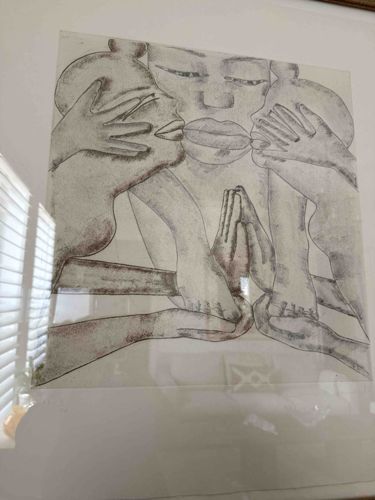
This artwork is a monochromatic fine art print, likely an etching or aquatint, attributed to the renowned Italian Neo-Expressionist artist Francesco Clemente. The composition features a complex, surrealist arrangement of human figures, characterized by the artist's signature obsession with the body, spirituality, and interconnectedness. The central motif depicts a large face with prominent, full lips and almond-shaped eyes, flanked by two smaller figures that appear to be merging with or held by the central form. Multiple sets of stylized hands are shown in various gestures, including a prayer-like position at the center and hands supporting the smaller figures' feet. The linework is delicate and expressive, with soft tonal shading provided by the aquatint process, creating a dreamlike atmosphere. The piece is printed on high-quality cream-toned paper with generous margins visible. In the lower-left corner outside the plate mark, there are pencil notations consistent with an edition number (e.g., 21/50), though the exact digits are partially obscured by light reflection. The overall condition appears excellent, with no visible foxing, tearing, or discoloration of the paper. The influence of Indian tantric art and classical mythology—themes frequent in Clemente's late 20th-century work—is highly evident in the anatomical distortions and mystical symbolism of the piece.
AI Appraisal Report

·AI can make mistakes·Verify before acting
I have virtually examined this monochromatic etching and aquatint attributed to Francesco Clemente. The piece exemplifies the Transavantgarde master's focus on nomadic identity and somatic spirituality. Based on my visual inspection, the work is a high-quality intaglio print on cream wove paper, exhibiting the delicate tonal gradations characteristic of aquatint. The linework is consistent with Clemente's idiosyncratic style, and the edition notation (e.g., 21/50) suggests a limited production run, which typically supports higher market value than open editions. The condition appears to be excellent; the paper lacks visible foxing or undulation, and the plate mark remains crisp. The market for Clemente's graphic works remains stable, with similar figurative prints from the 1980s and 90s fetching mid-four-figure sums at specialized fine art auctions. The value is bolstered by the artist's enduring institutional presence, though the monochromatic palette may command slightly less than his more vibrant, colored watercolors or prints. Crucially, while the aesthetic and technical qualities align with Clemente’s known body of work, I must note that a definitive attribution cannot be made from digital images alone. A formal authentication requires a physical inspection to verify the paper’s watermark, a microscopic analysis of ink absorption, and a review of provenance documentation or the artist's catalogue raisonné. To confirm the piece as an original limited edition, I would need to inspect the pencil signature and compare the edition stamps against known archives.

Get your items appraised

Instant estimates of your treasures with AI-powered appraisals

Browse More Appraisals