These notes were written by the person who submitted this item. Appraiser.AI has not verified them, and the AI's identification and estimate may rely on them.
AI Estimated Value
Not an official valuation
$800 - $1,200
AI estimate as of July 19, 2025 · verify with a professional before acting
AI-Generated · Verify before acting
Everything on this page is generated by AI for informational purposes only. AI can make mistakes — the AI may misidentify items or misattribute them (artist, maker, brand, designer, origin, era). This is not an official valuation and should not be used for insurance, sale, tax, estate, legal, or lending purposes — or any decision requiring a certified appraisal. It is not an authoritative claim about any person, brand, or rights holder — do not share or rely on it as a factual statement about a third party. Always consult qualified professionals before making financial decisions.
This analysis also relies on unverified notes provided by the user, which may be incomplete or inaccurate and could affect the result.
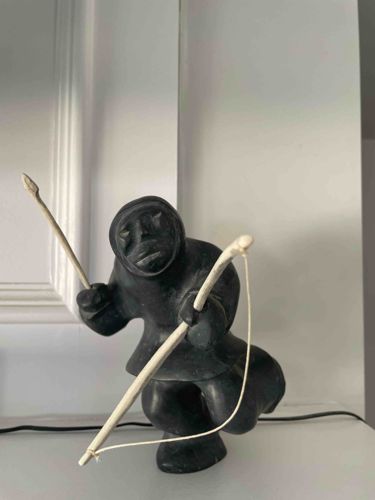
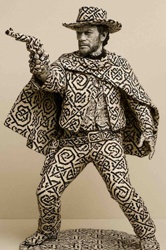
This is a hand-carved stone sculpture depicting an Inuit hunter in a dynamic, crouched pose, aiming a bow and arrow. The sculpture is crafted from a dark, possibly steatite or 'soapstone' material, exhibiting a semi-glossy finish that suggests polishing. The dark gray to black coloration is consistent throughout the figure, with only slight variations in tone visible, likely due to natural stone veins or light reflection. The hunter wears a parka with a defined hood, detailed subtly around the face. The facial features are stylized yet expressive, with deep-set eyes, a prominent nose, and a serious mouth. The hands are integrated into the overall form, holding a light-colored bow and a matching arrow, which appear to be made from a different material, possibly bone, antler, or light wood, strung with a thin, white cord. These lighter elements contrast sharply with the dark stone figure. The construction is solid and appears to be one continuous piece of stone for the main figure, with the bow and arrow being separate, attached components. There is a visible patina on the stone, indicative of its age and handling, but no obvious chips, cracks, or repairs are discernible from the image, suggesting good overall condition. The craftsmanship indicates a skilled artisan, with smooth contours and well-defined forms despite the minimalist style. The style points towards traditional Inuit art, likely from the mid to late 20th century. The piece demonstrates a sense of movement and narrative, capturing a specific cultural activity.
AI Appraisal Report
Upon examining the details of this Inuit Hunter Stone Sculpture with Bow and Arrow, I assess its condition to be quite good. The semi-glossy finish and visible patina suggest appropriate aging and handling, without apparent chips, cracks, or repairs. The integration of the bow and arrow, seemingly of a different material, indicates skillful assembly. The stylized yet expressive features and dynamic pose are hallmarks of traditional Inuit artistry. Based on visual cues, the piece appears authentic to the Inuit sculptural tradition, likely dating from the mid to late 20th century.
The market for authentic Inuit stone carvings remains consistent, driven by collectors appreciating cultural narrative and craftsmanship. Comparables typically include similar-sized action-oriented hunter figures, often in dark stone, by known or unknown artists. Pieces demonstrating this level of detail and narrative depth generally command higher prices. Demand is steady for well-preserved examples, making pieces like this moderately rare. Factors positively impacting value include the seemingly excellent condition and the evocative portrayal of a hunter in action.
Limitations in authenticity verification from images alone are notable. While the style strongly suggests Inuit origin, complete authentication would ideally require an in-person examination to verify the stone type (e.g., steatite/soapstone) and carving techniques, look for an artist's signature or disc number, and confirm the method of attachment for the bow and arrow. Provenance documentation, such as a certificate of authenticity or prior sales records, would significantly bolster confidence in its attribution and history. Scientific testing of the materials could provide definitive answers if necessary.