AI Appraisal Estimate

AI-generated estimates · not official valuations

From the user

What was submitted

Photo and notes provided by the user — not generated by AI

Submitted item photo
Submitted photo · May 18, 2026

User's notes

No additional notes provided.

AI analysis below

AI appraisal

AI analysis & estimate

AI-Generated · Verify before acting

Everything below is generated by AI for informational purposes only. AI can make mistakes — the AI may misidentify items or misattribute them (artist, maker, brand, designer, origin, era). This is not an official valuation and should not be used for insurance, sale, tax, estate, legal, or lending purposes — or any decision requiring a certified appraisal. It is not an authoritative claim about any person, brand, or rights holder — do not share or rely on it as a factual statement about a third party. Always consult qualified professionals before making financial decisions.

Read the full disclaimer

AI Identification

·Not independently authenticated·Verify before acting

Handmade Clay or Ceramic Studio Bead/Button

Artisanal Findings and Jewelry Components

AI Estimated Value

·Not an official valuation·Verify before acting

$15.00 - $35.00

As of May 18, 2026

AI Item Analysis

·AI can make mistakes·Verify before acting
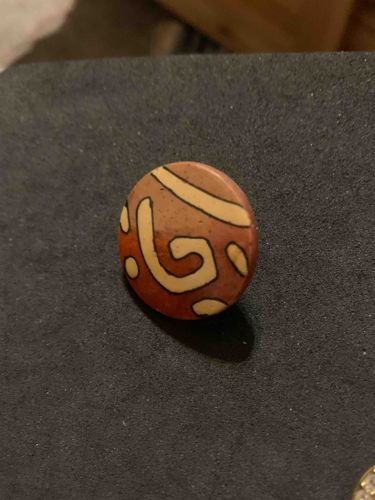
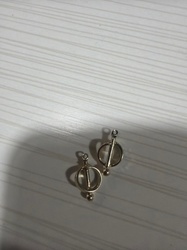
This item is a circular, dome-shaped object, likely a decorative bead, button, or lapel pin component, measuring approximately 1.5 to 2 centimeters in diameter. It is crafted from a ceramic or polymer clay material, featuring an earthy terracotta-brown base glaze with hand-painted cream-colored abstract 'bogolan' or tribal-inspired motifs. The aesthetic is characteristic of Studio Pottery or Artisanal jewelry movements from the late 20th century, specifically the 1970s through the 1990s. The surface exhibits a subtle matte finish with fine dark speckles embedded within the clay body, suggesting a rustic, high-fire ceramic process or a deliberate inclusion of 'grit' in a clay medium. The pattern consists of primitive swirls, dots, and curvilinear lines outlined in a darker pigment, reminiscent of West African textile patterns. Condition-wise, the item appears in good vintage state with no visible chips, cracks, or significant abrasions on the face. There is a slight unevenness in the circular perimeter, which confirms its handmade, non-industrial origin. The craftsmanship reflects an individual artisan's hand, prioritizing organic texture and folk-art style over mechanical symmetry. No maker's marks or stamps are visible from the top view, though they might exist on the reverse side.
AI Appraisal Report

·AI can make mistakes·Verify before acting
Based on my visual examination of this ceramic/clay component, I have assessed it as a studio-made artisanal bead or button, likely produced during the late 20th-century craft movement (circa 1975–1995). The item exhibits high-quality hand-painted motifs inspired by West African 'bogolan' designs. The condition is excellent, showing no crazing or chipping, which is vital for ceramic pieces of this scale. The presence of 'grit' or grog in the clay body and the organic, slightly asymmetrical perimeter are hallmark indicators of a hand-thrown or hand-pressed process rather than commercial casting. The global market for vintage studio components is niche but stable. Comparables for single, unsigned ceramic buttons or focal beads range from $10 to $40 depending on the prestige of the studio. While this piece shows high skill, the lack of a visible signature or hallmark limits its value to the utility/aesthetic category rather than a collected artist's work. Demand is driven by jewelry designers seeking unique 'found objects' for bespoke creations. Limitations: My assessment is based solely on a visual analysis of the face. A physical inspection is required to determine the attachment mechanism (shank vs. through-hole) and to check for maker's marks on the reverse. Scientific testing (X-ray diffraction or SEM) would be necessary to distinguish between high-fire earthenware and polymer clay, though the surface speckling strongly suggests traditional ceramics. Documentation of the original studio or kiln location would be required to elevate this from a generic 'artisanal finding' to a cataloged work of studio art.

Get your items appraised

Instant estimates of your treasures with AI-powered appraisals

Browse More Appraisals