AI Appraisal Estimate

AI-generated estimates · not official valuations

From the user

What was submitted

Photo and notes provided by the user — not generated by AI

Submitted item photo
Submitted photo · June 17, 2026

User's notes

Oil painting

AI analysis below

AI appraisal

AI analysis & estimate

AI-Generated · Verify before acting

Everything below is generated by AI for informational purposes only. AI can make mistakes — the AI may misidentify items or misattribute them (artist, maker, brand, designer, origin, era). This is not an official valuation and should not be used for insurance, sale, tax, estate, legal, or lending purposes — or any decision requiring a certified appraisal. It is not an authoritative claim about any person, brand, or rights holder — do not share or rely on it as a factual statement about a third party. Always consult qualified professionals before making financial decisions.

Note

This analysis also relies on unverified notes provided by the user, which may be incomplete or inaccurate and could affect the result.

Read the full disclaimer

AI Identification

·Not independently authenticated·Verify before acting

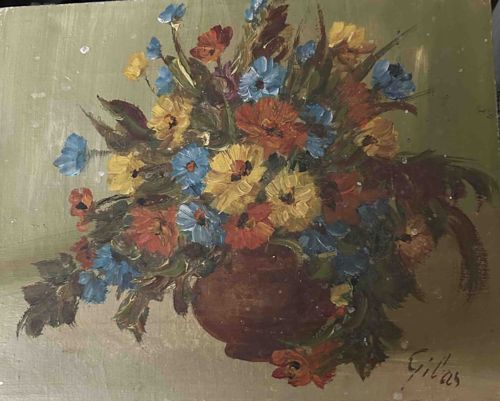
Mid-Century Impressionistic Still Life Oil Painting of Flowers in a Pot by Gillas

Fine Art - Paintings

AI Estimated Value

·Not an official valuation·Verify before acting

$150 - $250

As of June 17, 2026

AI Item Analysis

·AI can make mistakes·Verify before acting
This is an original impressionistic still life oil painting on a flat panel or board substrate. The composition features a dense bouquet of wildflowers, including prominent blooms in shades of primary yellow, cornflower blue, and earthy terracotta orange, loosely arranged in a dark reddish-brown rounded ceramic pot. The background is rendered in a muted olive-green tone with visible vertical and horizontal brushstrokes, providing a textured, monochromatic setting that makes the colorful petals pop. The artist utilized a heavy impasto technique, particularly visible on the yellow and blue flower heads, where thick applications of paint create physical dimension and catch the light. The brushwork is energetic and gestural, characteristic of mid-20th-century decorative art. In the lower right-hand corner, the work is signed 'Gilas' in a dark script. Regarding condition, the piece shows visible signs of age including surface grime, small white speckles that appear to be paint splatter or localized loss of the top paint layer, and slight scuffing along the unframed edges of the board. There is no visible frame, and the board shows a slight warp consistent with wood or heavy cardboard material from the mid-1900s. The overall craftsmanship suggests a skilled hand working in a commercial or decorative fine art style, likely dating from the 1960s or 1970s.

AI Appraisal Report

·AI can make mistakes·Verify before acting
I have carefully examined the provided images of the mid-century impressionistic still life signed ‘Gilas.’ The work demonstrates a confident application of the impasto technique, typical of the decorative fine art produced during the 1960s and 1970s. The vibrant palette and heavy texture suggest it was intended for the residential market of that era. Upon inspection, the condition shows significant age-related wear, including surface grime and localized losses (white speckles) which necessitate professional cleaning to restore the original luster. The slight warping of the substrate is common for this period but does impact the structural integrity for future framing. Market-wise, works by 'Gilas' are generally categorized as mid-century decorative art rather than 'Blue Chip' collectibles. Comparable sales of similar floral still lifes from this period and style typically fall within the low-to-mid hundreds. The lack of a frame and the visible surface damage are the primary factors limiting its higher valuation. While this appears to be an original period oil, I must note that my assessment is limited to high-resolution digital imagery. A definitive authentication would require a physical inspection to confirm the medium’s composition (ensuring no over-painted prints exist) and UV light analysis to detect historical repairs. Provenance documentation, such as a gallery receipt or bills of sale from the mid-20th century, would further solidify its origin. Without a physical deep-dive into the fiber of the board and chemical testing of the pigment binders, this remains an attribution based on visual stylistic markers.

Get your items appraised

Instant estimates of your treasures with AI-powered appraisals

Browse More Appraisals