AI estimate as of October 12, 2025 · verify with a professional before acting
AI-Generated · Verify before acting
Everything on this page is generated by AI for informational purposes only. AI can make mistakes — the AI may misidentify items or misattribute them (artist, maker, brand, designer, origin, era). This is not an official valuation and should not be used for insurance, sale, tax, estate, legal, or lending purposes — or any decision requiring a certified appraisal. It is not an authoritative claim about any person, brand, or rights holder — do not share or rely on it as a factual statement about a third party. Always consult qualified professionals before making financial decisions.
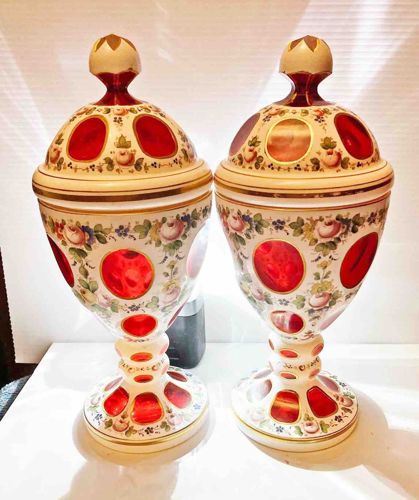
This is a pair of lidded urns, likely Bohemian in origin, crafted from cut-to-clear glass. Each urn features a vibrant ruby red interior that is revealed through expertly cut circular and oval facets on the exterior, creating a striking contrast with the opaque white enamel overlay. The white enamel surface is meticulously hand-decorated with polychrome floral motifs, primarily consisting of pink roses with green foliage and blue accents, running in bands around the body, lid, and base of each urn. Gold gilt accents are present, enhancing the decorative elements and outlining the borders of the various sections, including thin bands around the lid and mid-section. The urns have a classical goblet-like silhouette, comprising a footed base, a waisted stem, a bulbous body, and a domed lid topped with a finial. The finial itself is also enamel-decorated with a stylized pattern, and a rich red color highlights the neck of the finial as well as the cut sections within the glass. Visible condition appears good, with no obvious chips, cracks, or significant loss to the enamel decoration discernable from the image. The gilding seems largely intact, suggesting careful preservation. The craftsmanship indicates a high level of skill in glass blowing, cutting, enameling, and gilding, characteristic of 19th-century Bohemian artistry. The intricate decorative work and the cut-to-clear technique are hallmarks of quality antique ornamental glassware. No specific maker's marks or signatures are visible in the provided image. The estimated age is likely mid-to-late 19th century, a period when Bohemian glass was highly sought after for its decorative appeal and elaborate designs.
AI Appraisal Report
Based on my visual examination of the provided image, this pair of Bohemian Ruby Cut-to-Clear and Enamel Decorated Lidded Urns appears to be a fine example of 19th-century glass artistry. The condition seems remarkably good; I can discern no obvious chips, cracks, or significant losses to the intricate enamel decoration or gilding, which is impressive for items of this age. The cut-to-clear technique with the vibrant ruby red contrasting the opaque white enamel is a hallmark of quality Bohemian production from the mid-to-late 19th century. The polychrome floral motifs, particularly the pink roses, combined with the classical silhouette, are consistent with the aesthetic tastes of that period and suggest authenticity as period pieces.
Market conditions for high-quality antique Bohemian glass, especially well-preserved pairs, remain stable. There is a consistent demand from collectors for such elaborately decorated and skillfully crafted items. The combination of cut-to-clear, enameling, and gilding makes these pieces more desirable than simpler examples. Comparables for similar high-quality lidded urns or vases from this era and region, exhibiting excellent condition and decorative complexity, typically fetch prices within the estimated range.
Factors significantly impacting value here are the excellent apparent condition, the intricate decorative work, the desirable ruby-red cut-to-clear technique, and the presentation as a pair. Rarity is moderate; while Bohemian glass was produced in volume, pieces of this caliber and condition are less common.
It is crucial to note the limitations of authentication based solely on images. While these urns exhibit all the characteristics of authentic 19th-century Bohemian glass, a definitive authenticity verification would require in-person examination. This would allow for inspection of internal clarity, glass composition under UV light, examination of seam lines (if any), tactile assessment of the enamel and gilding, and investigation for any subtle repairs or restorations that might not be visible in photographs. Additionally, any provenance documentation would significantly enhance certainty regarding their history and origin.