Tumbled Amazonite Stone
Minerals & Gemstones

Tumbled Amazonite Stone

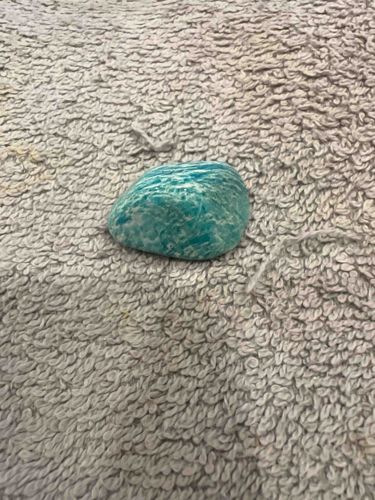
This item is a single tumbled specimen of Amazonite, a variety of microcline feldspar. The stone exhibits a vibrant turquoise-green to aqua-blue hue, which is characteristic of high-quality Amazonite caused by traces of lead. It features a prominent white schiller or 'matrix' of streaks and patches throughout, creating a marbled or lace-like pattern common in this mineral species. The stone has been mechanically tumbled and polished to a smooth, waxy luster, resulting in an irregular, rounded, and pebble-like shape. While there are no visible maker's marks, as it is a natural mineral product, the craftsmanship of the polish appears high, showing a glossy finish with minimal surface pitting or visible cracks. There are no significant chips or damage apparent in the photograph, though natural internal fractures (cleavage planes) are visible through the translucent to opaque surface. This material is widely sourced from locations like Brazil, Russia, or the United States and is commonly used in holistic practices, lapidary arts, or as a decorative pocket stone. Its age is geologic, though the processing (tumbling) is likely contemporary.
Estimated Value

$5.00-$8.00

Basic Information

Category

Minerals & Gemstones

Appraised On

March 3, 2026

Estimated Value

$5.00-$8.00

Item Description

This item is a single tumbled specimen of Amazonite, a variety of microcline feldspar. The stone exhibits a vibrant turquoise-green to aqua-blue hue, which is characteristic of high-quality Amazonite caused by traces of lead. It features a prominent white schiller or 'matrix' of streaks and patches throughout, creating a marbled or lace-like pattern common in this mineral species. The stone has been mechanically tumbled and polished to a smooth, waxy luster, resulting in an irregular, rounded, and pebble-like shape. While there are no visible maker's marks, as it is a natural mineral product, the craftsmanship of the polish appears high, showing a glossy finish with minimal surface pitting or visible cracks. There are no significant chips or damage apparent in the photograph, though natural internal fractures (cleavage planes) are visible through the translucent to opaque surface. This material is widely sourced from locations like Brazil, Russia, or the United States and is commonly used in holistic practices, lapidary arts, or as a decorative pocket stone. Its age is geologic, though the processing (tumbling) is likely contemporary.

Get Your Items Appraised

Instant estimates of your treasures with AI-powered instant appraisals

Browse More Appraisals