AI estimate as of July 13, 2025 · verify with a professional before acting
AI-Generated · Verify before acting
Everything on this page is generated by AI for informational purposes only. AI can make mistakes — the AI may misidentify items or misattribute them (artist, maker, brand, designer, origin, era). This is not an official valuation and should not be used for insurance, sale, tax, estate, legal, or lending purposes — or any decision requiring a certified appraisal. It is not an authoritative claim about any person, brand, or rights holder — do not share or rely on it as a factual statement about a third party. Always consult qualified professionals before making financial decisions.
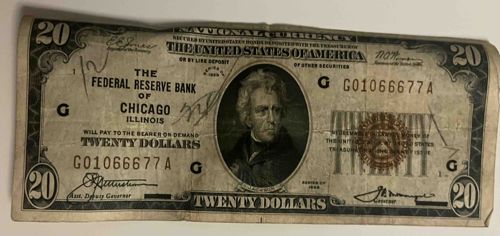
This item is an antique or vintage twenty-dollar bill, specifically a Federal Reserve Note from the series of 1914. The obverse features an oval portrait of President Andrew Jackson centered. To the left of the portrait, it clearly states 'THE FEDERAL RESERVE BANK OF CHICAGO ILLINOIS' and 'WILL PAY TO THE BEARER ON DEMAND TWENTY DOLLARS'. Below this text, the serial number 'G01066677A' is printed twice, once on the lower left and again on the upper right side of the bill. The number '20' is prominently displayed in all four corners, indicating the denomination. A large letter 'G' is also visible on both the left and right sides, indicating the Federal Reserve Bank district (Chicago). The signatures of the Asst. Deputy Governor and the Governor are present at the bottom. A distinguishing feature is the large brown Treasury seal to the right of Jackson's portrait, which is characteristic of the 1914 series. The bill's color is a faded green and off-white, typical of aged currency made from cotton and linen fiber.
In terms of condition, the bill shows significant signs of wear and age. There are several prominent vertical and horizontal folds, suggesting it has been extensively circulated. The paper appears soft and possibly thin in areas due to wear, and there is visible discoloration and dirt accumulation across the surface. While no major rips or tears are immediately apparent, the edges show some fraying and softening. The ink, particularly the black elements and the brown seal, appears faded but remains legible. The overall impression is that of a well-used but largely intact piece of historical currency. The craftsmanship is typical of early 20th-century US currency, featuring intricate engraving for security and aesthetic purposes.
AI Appraisal Report
I have carefully examined the provided image of this 1914 Series Twenty Dollar Federal Reserve Note from Chicago. Authenticity, based solely on visual assessment, appears high. All key features, including the portrait of Andrew Jackson, the 'Federal Reserve Bank of Chicago Illinois' text, the double serial number 'G01066677A', the prominent '20's, the 'G' district markers, signatures, and the large brown Treasury seal, align with known characteristics of genuine 1914 series notes. The faded green and off-white coloring, typical of aged currency, also support its authenticity.
In terms of condition, this note exhibits significant wear, consistent with extensive circulation. I observe prominent vertical and horizontal folds, visible discoloration, and dirt accumulation. The paper appears soft and possibly thin, and the edges show fraying. While no major rips are apparent from the image, these condition issues place the note firmly in the "Good" to "Very Good" range according to numismatic grading standards. This level of wear significantly impacts value, as collectors generally prefer higher-grade examples.
Market conditions for 1914 series Federal Reserve Notes are stable, though demand for notes in this condition is moderate. Rarity is low to moderate; while these notes are old, they are not exceedingly rare, especially in lower grades. The Chicago district (G) is neither particularly scarce nor common.
Key factors impacting value are overwhelmingly negative due to condition. A crisp, uncirculated example would command a significantly higher price. Comparables for 1914 $20 FRNs in "Good" to "Very Good" condition typically range from $150 to $300.
My assessment of authenticity is limited by the image. For full authentication, I would require an in-person examination to verify paper feel, detect potential repairs, assess the print quality under magnification, and confirm ink integrity. Scientific testing (e.g., paper composition, ink analysis) and provenance documentation would further bolster authenticity and provide a more definitive appraisal.