AI Appraisal Estimate

AI-generated estimates · not official valuations

From the user

What was submitted

Photo and notes provided by the user — not generated by AI

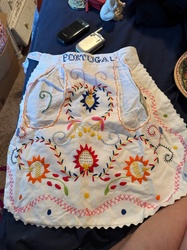
Submitted item photo
Submitted photo · May 23, 2026

User's notes

No additional notes provided.

AI analysis below

AI appraisal

AI analysis & estimate

AI-Generated · Verify before acting

Everything below is generated by AI for informational purposes only. AI can make mistakes — the AI may misidentify items or misattribute them (artist, maker, brand, designer, origin, era). This is not an official valuation and should not be used for insurance, sale, tax, estate, legal, or lending purposes — or any decision requiring a certified appraisal. It is not an authoritative claim about any person, brand, or rights holder — do not share or rely on it as a factual statement about a third party. Always consult qualified professionals before making financial decisions.

Read the full disclaimer

AI Identification

·Not independently authenticated·Verify before acting

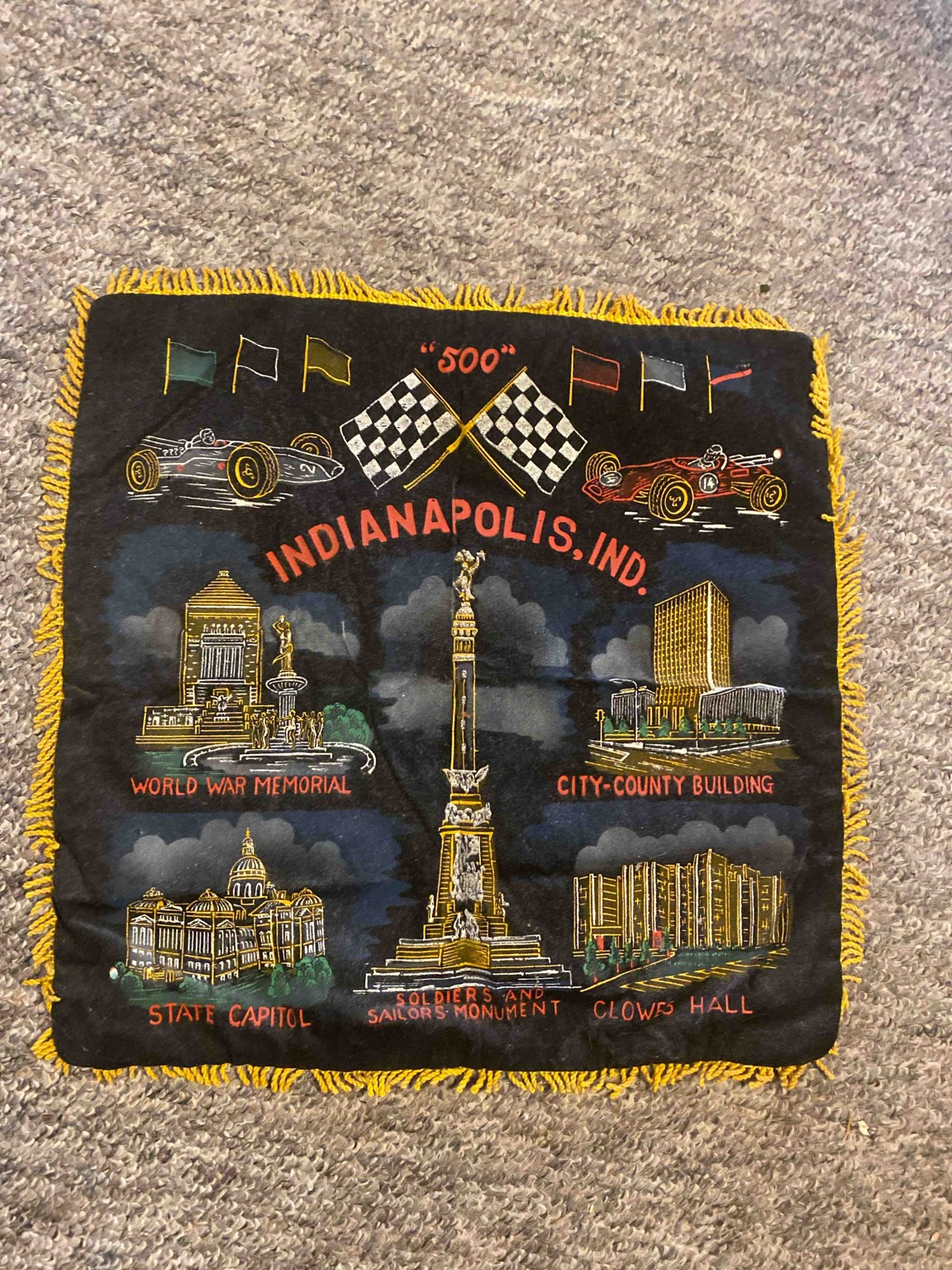
Vintage Indianapolis Souvenir Pillow Sham with Racing and Landmark Graphics

Vintage Souvenirs / Textiles

AI Estimated Value

·Not an official valuation·Verify before acting

$45.00 - $65.00

As of May 23, 2026

AI Item Analysis

·AI can make mistakes·Verify before acting
This is a vintage souvenir pillow sham or coverlet from Indianapolis, Indiana, likely dating from the mid-1960s to early 1970s. The item is constructed from a dark navy or black felt-like fabric, featuring a square shape with a bright yellow or gold fringe border along all four edges. The design is screen-printed in multiple vibrant colors, including red, white, yellow, and green. The top portion celebrates the Indianapolis 500 motor race, depicting two vintage-style open-wheel race cars flanking crossed checkered flags, a series of signaling flags, and the number '500'. Below this is the text 'INDIANAPOLIS, IND.' in a curved red font. The central and lower portions of the sham feature a montage of five major local landmarks: the World War Memorial, the State Capitol, the Sailors and Soldiers Monument, the City-County Building, and Clowes Hall. Each landmark is illustrated in a detailed, illustrative style with bold outlines and localized color accents. The City-County Building, which was completed in 1962, and the depiction of Clowes Hall (opened 1963) help date the piece to the post-1963 era. The condition appears fair to good; there is visible creasing throughout the fabric and slight fading to the screen-printed colors. The fringe is mostly intact but shows minor tangling. No significant stains, holes, or frayed edges are immediately apparent in the photograph, though the fabric shows a slight texture indicative of age and handling.
AI Appraisal Report

·AI can make mistakes·Verify before acting
I have virtually examined this mid-century Indianapolis souvenir pillow sham, which appears to be an authentic example of tourist-focused textiles from the mid-1960s. The inclusion of the City-County Building (1962) and Clowes Hall (1963) confirms the item was likely produced between 1963 and 1970, capturing a specific era of urban development in Indiana. The use of screen-printing on felt with a gold fringe border is consistent with late-stage souvenir manufacturing styles before the transition to fully synthetic materials. The condition is observed as fair-to-good. The heavy creasing suggests long-term storage under pressure, which can occasionally damage the integrity of old screen-print pigments, causing flaking or 'crazing.' However, the vibrancy remains acceptable. Collectors of 'Indy 500' ephemera or regional Hoosier history are the primary market here. The 'Indy 500' imagery provides a higher floor for the price than a standard municipal souvenir would alone. Market demand for mid-century regional felt items is stable but localized. Comparables for similar mid-western felt banners and shams typically realize between $30 and $75 depending on the specific iconography. The rarity is moderate; while these were mass-produced, many were discarded or suffered moth damage. Limitations: My assessment is based on visual data only. A physical inspection is required to determine the exact fiber content (wool vs. synthetic blend) and to check for hidden dry rot or odors. To fully authenticate, I would need to examine the reverse side for original manufacturer labels and verify the ink adhesion. Scientific testing of dyes would be required to rule out modern digital replicas, though the specific 'foxing' and texture suggest period-correct manufacturing.

Get your items appraised

Instant estimates of your treasures with AI-powered appraisals

Browse More Appraisals