These notes were written by the person who submitted this item. Appraiser.AI has not verified them, and the AI's identification and estimate may rely on them.
AI Estimated Value
Not an official valuation
$40-70
AI estimate as of July 2, 2025 · verify with a professional before acting
AI-Generated · Verify before acting
Everything on this page is generated by AI for informational purposes only. AI can make mistakes — the AI may misidentify items or misattribute them (artist, maker, brand, designer, origin, era). This is not an official valuation and should not be used for insurance, sale, tax, estate, legal, or lending purposes — or any decision requiring a certified appraisal. It is not an authoritative claim about any person, brand, or rights holder — do not share or rely on it as a factual statement about a third party. Always consult qualified professionals before making financial decisions.
This analysis also relies on unverified notes provided by the user, which may be incomplete or inaccurate and could affect the result.
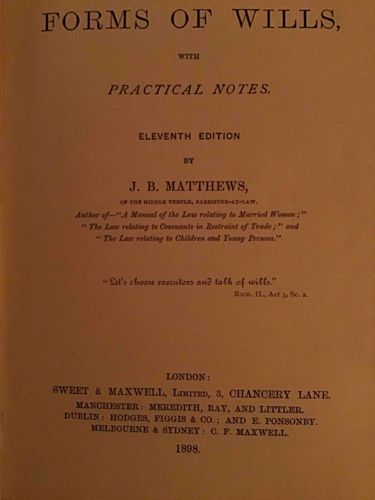
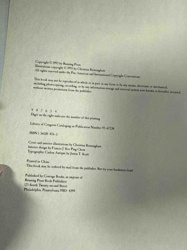
This item is the title page of a legal textbook titled 'Forms of Wills, With Practical Notes.' It is the eleventh edition, authored by J. B. Matthews, who is identified as being 'of The Middle Temple, Barrister-At-Law.' The author is also credited with other works, including 'A Manual of the Law relating to Married Women,' 'The Law relating to Covenants in Restraint of Trade,' and 'The Law relating to Children and Young Persons.' The page features a quote: '“Let's choose executors and talk of wills.” RICH. II., Act II., Sc. 1.' The imprint indicates major publishing houses and their locations: Sweet & Maxwell, Limited, 3, Chancery Lane, London; Meredith, Ray, and Littler, Manchester; Hodges, Figgis & Co., and E. Ponsonby, Dublin; and C. F. Maxwell, Melbourne & Sydney. The publication year is clearly stated as 1898. The page itself appears to be made of paper, with a warm, aged, light brown or sepia tone, suggesting its vintage. The text is printed in black or very dark ink, utilizing various font styles and sizes for hierarchy—larger, bolder fonts for the title and author, and smaller fonts for additional details and publisher information. The overall physical characteristic observed from the image is the slight discoloring of the paper with age. As described, the item is in good condition, showing no significant tears, stains, or creases on the visible title page, consistent with a well-preserved antique book.
AI Appraisal Report
I have carefully examined the provided image of the title page from 'Forms of Wills, With Practical Notes, Eleventh Edition' by J. B. Matthews, published in 1898. Based on this visual inspection and the owner’s description of ‘good condition,’ the item appears to be well-preserved for its age. The paper shows expected age-toning, consistent with a vintage book, and there are no visible tears, significant stains, or creases on this page, suggesting a generally good state of preservation for the entire volume.
This is a legal textbook from the late 19th century. While historical legal texts have niche appeal, the subject matter, "Forms of Wills," is quite specific. The author, J.B. Matthews, while prolific in his field, is not a figure whose works typically command high prices in the broader antiquarian book market. Demand for such items is generally limited to legal historians, specialized collectors of British legal bibliography, or those with a personal connection to the author or period. Its rarity is moderate; while an 11th edition suggests multiple printings, 1898 editions of specialized texts are not exceedingly common, but neither are they truly scarce.
Factors impacting value include the book's specific legal topic, which narrows its collector base, and its age. The primary limitation of this appraisal is that it is based solely on a single image of the title page and the owner's subjective assessment of "good condition." A full authentication and precise condition assessment would require a complete physical examination of the entire volume to check for foxing, binding integrity, completeness of all pages, presence of maps or illustrations (if any), and any hidden repairs or defects. Provenance documentation, though unlikely for a book of this type, would also be beneficial but not strictly necessary for valuation. Without a full inspection, the appraisal assumes the rest of the book aligns with the condition seen on the title page.
Considering these factors, the item's value is primarily as a historical artifact for a specialized collector.