AI estimate as of August 25, 2025 · verify with a professional before acting
AI-Generated · Verify before acting
Everything on this page is generated by AI for informational purposes only. AI can make mistakes — the AI may misidentify items or misattribute them (artist, maker, brand, designer, origin, era). This is not an official valuation and should not be used for insurance, sale, tax, estate, legal, or lending purposes — or any decision requiring a certified appraisal. It is not an authoritative claim about any person, brand, or rights holder — do not share or rely on it as a factual statement about a third party. Always consult qualified professionals before making financial decisions.
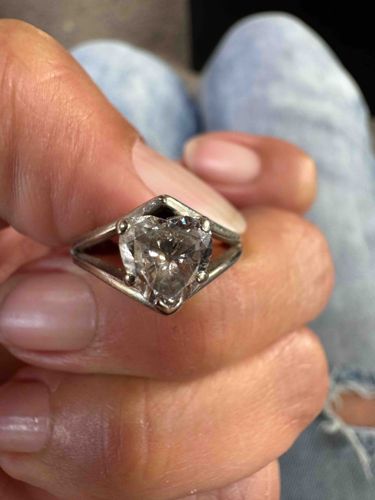
This item is a ring featuring a prominent heart-shaped gemstone, likely a diamond based on its brilliance and facets. The gem is set in a white metal, appearing to be silver, white gold, or platinum, given its bright, reflective luster. The setting is a bezel or partial bezel style that cradles the heart-shaped stone, with additional metal work forming a split-shank band that converges towards the setting. The band itself has a distinctive architectural or geometric design, possibly featuring a 'V' shape or similar angular elements that frame the central stone. The metal shows some evidence of wear consistent with a frequently worn piece of jewelry, such as minor scratches or scuffs on the surface, and some darkening in the deeper recesses of the setting, which could indicate patina or accumulated dirt, common for older pieces or those that have not been recently cleaned. The craftsmanship appears solid, with clean lines on the setting and band, though no specific maker's marks or signatures are discernible from the provided image. The overall style suggests a modern or contemporary design, possibly from the late 20th to early 21st century, given its clean lines and minimalist approach to framing the main stone. The stone itself has good clarity and shows sparkle, indicating decent cut quality, although precise characteristics like carat weight, color, and absolute clarity cannot be determined without a direct inspection.
AI Appraisal Report
Upon my virtual examination of this Heart-Shaped Gemstone Ring, I observe a well-crafted piece featuring a prominent heart-shaped brilliant-cut gemstone set in a white metal. The stone exhibits excellent brilliance and fire, strongly suggesting it is a diamond, though I cannot definitively confirm its identity, precise carat weight, color, or clarity without direct inspection. The setting appears to be a partial bezel, securely cradling the stone, with a distinctive split-shank band that merges into an angular, possibly 'V'-shaped design near the central setting.
The condition appears consistent with regular wear, showing minor surface scuffs and scratches on the metal, and some darkening in recesses, which could be accumulated debris or tarnish – common for a piece that has been worn and not recently professionally cleaned. The craftsmanship of the setting and band seems solid, with clean lines indicative of a quality manufactured piece. The overall style suggests a contemporary design, likely from the late 20th or early 21st century.
Market conditions for heart-shaped diamond rings remain stable, driven by their romantic appeal. Comparables include rings of similar design and presumed diamond quality sold at fine jewelry retailers. Demand for heart-shaped diamonds is consistent, though perhaps not as high as round brilliants, making them less rare but still desirable. Factors significantly impacting value include the actual carat weight, color, clarity, and cut quality of the central stone, the purity and weight of the metal (e.g., 14k or 18k white gold vs. platinum), and the presence of any reputable designer marks, none of which are visible here.
In terms of limitations for authenticity verification, from images alone, I cannot definitively confirm the gemstone is a natural diamond versus a simulant (like moissanite or cubic zirconia) or a lab-grown diamond. An in-person examination, including precise measurements, diamond testing (e.g., thermal conductivity, specific gravity), and spectroscopic analysis would be essential. Furthermore, assessing metal purity would require hallmarks or XRF testing. Provenance documentation (e.g., original sales receipts or diamond certificates) would also be crucial to fully authenticate the materials and potentially assign a designer premium.