These notes were written by the person who submitted this item. Appraiser.AI has not verified them, and the AI's identification and estimate may rely on them.
AI Estimated Value
Not an official valuation
$600-900
AI estimate as of November 17, 2025 · verify with a professional before acting
AI-Generated · Verify before acting
Everything on this page is generated by AI for informational purposes only. AI can make mistakes — the AI may misidentify items or misattribute them (artist, maker, brand, designer, origin, era). This is not an official valuation and should not be used for insurance, sale, tax, estate, legal, or lending purposes — or any decision requiring a certified appraisal. It is not an authoritative claim about any person, brand, or rights holder — do not share or rely on it as a factual statement about a third party. Always consult qualified professionals before making financial decisions.
This analysis also relies on unverified notes provided by the user, which may be incomplete or inaccurate and could affect the result.
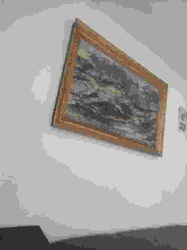
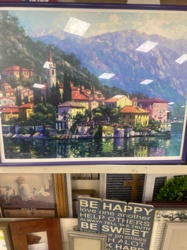
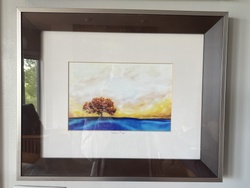
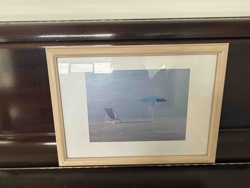
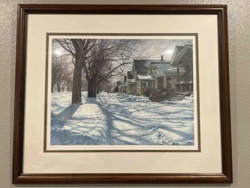
This is an oil painting depicting a vibrant floral still life, predominantly featuring a large bouquet of roses and various other blossoms. The painting is set within a traditional, possibly gilded, wooden frame. The composition centers on a dense cluster of flowers, including prominent pink and white roses with their characteristic layered petals, intermingled with blue irises or delphiniums, smaller white fillers, and various other pink, red, and yellow-orange blooms. A darker background, possibly suggesting a vase or container, supports the bouquet. The colors are rich and applied with visible brushstrokes, indicating a painterly style. The frame appears to be made of wood with an ornate, possibly carved or molded, design featuring a gold finish, showing some signs of wear and age, such as minor chips or tarnishing, consistent with its style and potential age. The painting itself exhibits a warm, somewhat muted palette in the background which contrasts with the lively colors of the flowers. There are no immediately visible signatures or maker's marks from the provided image. The overall style suggests a traditional or classical approach to still life painting, possibly dating from the late 19th to early 20th century, or a more contemporary piece emulating this style. The condition appears fair, with no obvious major damage to the canvas, but without closer inspection, tears, cracks, or paint loss cannot be definitively ruled out. The painting demonstrates good craftsmanship in its composition and color use, creating a sense of depth and realism for the blossoms.
AI Appraisal Report
Based on my visual examination of the provided image, this oil painting, 'Floral Still Life with Roses and Assorted Blooms,' presents as a charming and well-executed example of a traditional floral still life. The condition appears fair; I observe no obvious major damage like tears or significant paint loss from the image. The colors remain vibrant, and the brushwork suggests a skilled hand. The frame, while showing some age-consistent wear such as minor chips or tarnishing on its gilded finish, complements the artwork’s traditional aesthetic.
From the image alone, authenticating the artist or precise age is impossible. The style is consistent with late 19th to early 20th-century floral still life painters, or a contemporary artist working in a similar vein. Without a visible signature or provenance, it's categorized as 'decorative' rather than by a recognized artist, which significantly impacts its market value. Comparables for unsigned, decorative floral still lifes of this apparent quality typically range from $400 to $1,000, depending on size, condition, and presentation. Demand for such pieces is generally steady among collectors of traditional art, but it is not rare.
Factors impacting this value include its good aesthetic appeal and decorative quality. However, the lack of an identifiable artist and the unsigned nature limit its potential for significantly higher appreciation. For full authentication and a more precise valuation, an in-person examination would be critical to assess the canvas, paint layers, and frame condition more accurately. Additionally, professional cleaning or an art conservator's report could reveal hidden signatures or details. Provenance documentation, if available, would be invaluable.