AI Appraisal Estimate

AI-generated estimates · not official valuations

From the user

What was submitted

Photo and notes provided by the user — not generated by AI

Submitted item photo
Submitted photo · May 26, 2026

User's notes

No additional notes provided.

AI analysis below

AI appraisal

AI analysis & estimate

AI-Generated · Verify before acting

Everything below is generated by AI for informational purposes only. AI can make mistakes — the AI may misidentify items or misattribute them (artist, maker, brand, designer, origin, era). This is not an official valuation and should not be used for insurance, sale, tax, estate, legal, or lending purposes — or any decision requiring a certified appraisal. It is not an authoritative claim about any person, brand, or rights holder — do not share or rely on it as a factual statement about a third party. Always consult qualified professionals before making financial decisions.

Read the full disclaimer

AI Identification

·Not independently authenticated·Verify before acting

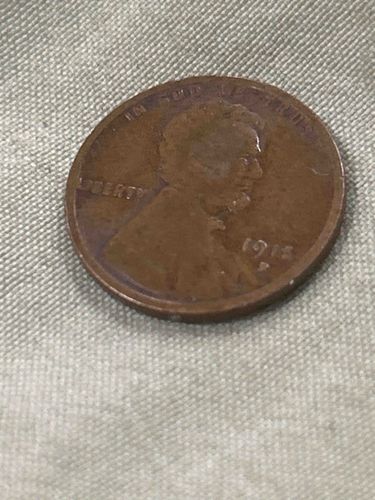
1918 Lincoln Wheat Cent

Coin

AI Estimated Value

·Not an official valuation·Verify before acting

$0.50 - $1.50

As of May 26, 2026

AI Item Analysis

·AI can make mistakes·Verify before acting
The item is a copper-colored coin, appearing to be a United States one-cent piece, commonly known as a penny. The visible side, the obverse, features the right-facing profile of Abraham Lincoln, a design synonymous with the Lincoln Cent series first issued in 1909. Above Lincoln's head along the rim, partially visible text likely reads "IN GOD WE TRUST." To his left, the word "LIBERTY" is partially discernable, with the date "1918" clearly stamped below his bust. The coin exhibits a somewhat worn appearance, consistent with its age and circulation. The details of Lincoln's portrait are still quite clear, though some of the finer lines of his hair and facial features show smoothing. The color is a uniform coppery-brown, suggesting a standard copper composition and a natural patina from age and exposure. There are no obvious signs of significant damage such as deep scratches, bends, or corrosion, although the surface shows typical signs of handling and minor abrasions. The rim appears mostly intact. The visible condition suggests a circulated coin in perhaps fair to good condition, which would typically be evaluated further for specific grading criteria to determine wear levels and any unique defining characteristics that could affect its numismatic value. There are no visible mint marks on this side, which would typically be below the date; however, the resolution may not be sufficient to confirm their absence or presence distinctly for a complete appraisal.

AI Appraisal Report

·AI can make mistakes·Verify before acting
I have examined the provided image of what appears to be a 1918 Lincoln Wheat Cent. The coin presents as a genuine U.S. one-cent piece from that era, consistent with known visual characteristics for Lincoln cents. The obverse details, including Lincoln's profile, the date “1918,” and partially visible mottos, align with official mint designs. In terms of condition, I assess this coin to be in 'Good to Very Good' (G-VG) circulated condition. The outlines of Lincoln's features are discernible, but significant smoothing is evident on the higher points, such as his hair and jawline. The fields show typical wear and minor abrasions consistent with a coin that has circulated for many years. The coppery-brown coloration is natural patina, and there are no immediate signs of detrimental damage like heavy scratches, corrosion, or environmental damage, which would significantly detract from its value. The rim appears mostly intact. Market conditions for common date circulated Lincoln Wheat Cents like the 1918 are stable and generally low. There is a consistent but not high demand from entry-level collectors or those seeking to fill date sets. Rarity is not a factor for this particular issue and condition; the 1918 mintage was high. For comparison, a similar 1918 Lincoln Cent in G-VG condition typically trades in the range of fifty cents to a dollar and a half. The most significant limitation of appraising from an image alone is the inability to thoroughly inspect the reverse side for any mint marks (D for Denver or S for San Francisco, which would be below the date) or other anomalies, and to assess the coin's true weight, thickness, and metallic composition. An in-person examination would allow for a precise grading, confirmation of the absence or presence of a mint mark, and verification against known authentic examples to fully rule out counterfeiting (though highly unlikely for a common date in this condition). No provenance documentation or scientific testing is typically needed for such a common and low-value coin, beyond a detailed physical inspection.

Get your items appraised

Instant estimates of your treasures with AI-powered appraisals

Browse More Appraisals