AI estimate as of September 5, 2025 · verify with a professional before acting
AI-Generated · Verify before acting
Everything on this page is generated by AI for informational purposes only. AI can make mistakes — the AI may misidentify items or misattribute them (artist, maker, brand, designer, origin, era). This is not an official valuation and should not be used for insurance, sale, tax, estate, legal, or lending purposes — or any decision requiring a certified appraisal. It is not an authoritative claim about any person, brand, or rights holder — do not share or rely on it as a factual statement about a third party. Always consult qualified professionals before making financial decisions.
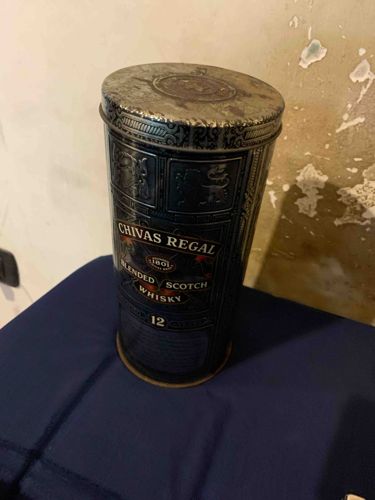
This item is a cylindrical tin container designed to hold a bottle of Chivas Regal 12 Year Old Blended Scotch Whisky. The tin is predominantly dark blue or black with ornate silver-toned decorative elements, including what appears to be embossed or relief-printed heraldic motifs such as lions and other crest-like designs arranged in framed panels around the body. The prominent branding 'CHIVAS REGAL' is displayed horizontally in a lighter, possibly gold or cream, color. Below this, '1801' is visible within a small, circular or oval emblem, indicating the brand's founding year. Further down, 'BLENDED SCOTCH WHISKY' is printed, and at the bottom, the age statement '12' is clearly visible. The lid is also metal, circular, and features a similar silver-toned, ornate design, though it is heavily discolored and shows significant signs of age and wear. The overall condition of the tin displays notable aging, including discoloration, scuffs, scratches, and possible oxidation, particularly on the top surface, which has a dull, mottled patina. The metal rim at the base of the tin also shows some tarnishing. The construction appears to be standard for a mass-produced promotional tin of this type, likely made of tinplate steel. The quality of the embellishments suggests a mid-20th century to late 20th-century design period, typical of premium spirit packaging intended for retail display and protection. The visible wear indicates prolonged exposure or handling, suggesting it is a used or vintage item.
AI Appraisal Report
Upon examining the provided image of this Chivas Regal Blended Scotch Whisky 12 Year Old Tin, I can offer the following appraisal. The tin is a standard cylindrical promotional container, likely from the mid to late 20th century, given its design aesthetics, which is typical for premium spirits packaging. Its primary function was retail display and bottle protection. While the ornate silver-toned heraldic motifs and 'CHIVAS REGAL' branding are attractive, the overall condition is moderately poor. I observe significant discoloration, scuffs, scratches, and particularly heavy oxidation/tarnishing on the lid and base rim, which severely detracts from its visual appeal. This level of wear indicates prolonged exposure or handling, suggesting it is a used, vintage item rather than new old stock.
Regrettably, the market for mass-produced spirits tins like this, even vintage ones, is generally not robust unless they are exceptionally rare, pristine, or associated with a significant historical event. This particular Chivas Regal 12-year-old tin is quite common. Comparable sales of similar Chivas Regal tins in good to very good condition typically fetch between $15 and $30. Given the significant visible wear, especially on the top lid, this tin falls on the lower end of that spectrum, if not below it. There is no indication of rarity, and demand is limited primarily to niche collectors of whisky memorabilia or branding.
Factors impacting value negatively are primarily its condition and its widespread availability. Positive factors are minimal, mainly its recognizability as a Chivas Regal item.
Regarding authentication, visual examination is sufficient to confirm this is a genuine Chivas Regal tin of its type. However, without physical inspection, I cannot ascertain the exact manufacturing date or material composition beyond 'tinplate steel.' In-person examination would allow for closer scrutiny of embossed details, internal condition, and any hidden wear not visible in the image. Provenance documentation or scientific testing is not typically applied to items of this modest value for authentication purposes, as their cost would far exceed the item's worth.