AI estimate as of September 26, 2025 · verify with a professional before acting
AI-Generated · Verify before acting
Everything on this page is generated by AI for informational purposes only. AI can make mistakes — the AI may misidentify items or misattribute them (artist, maker, brand, designer, origin, era). This is not an official valuation and should not be used for insurance, sale, tax, estate, legal, or lending purposes — or any decision requiring a certified appraisal. It is not an authoritative claim about any person, brand, or rights holder — do not share or rely on it as a factual statement about a third party. Always consult qualified professionals before making financial decisions.
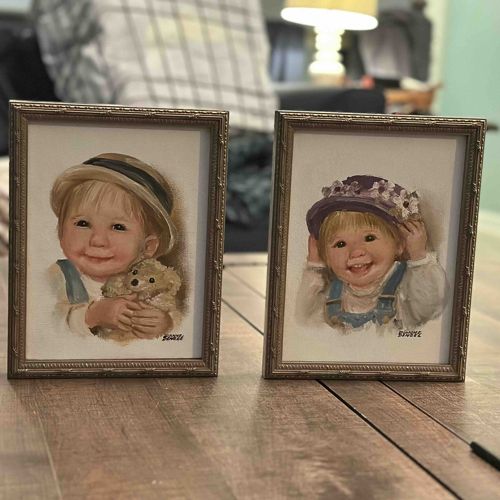
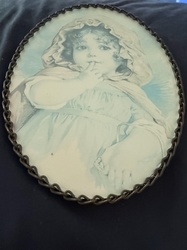
This lot features a pair of small, framed portrait prints, likely reproductions of paintings, depicting young children. Each print is housed in a matching rectangular frame made of what appears to be a metallic or metallic-finished material, possibly brass or a patinated gold-tone metal, featuring a rope-twist or reeded outer edge and a textured inner bevel. The frames have a classic, somewhat ornate design. The print on the left shows a fair-haired child, possibly a toddler, with rosy cheeks and a happy expression, wearing a straw-colored hat with a dark band and light blue overalls, holding a small tan-colored teddy bear. The artist's signature, 'Broske', is visible in the lower right corner of this print. The print on the right depicts a similar fair-haired child, again with a joyful, open-mouthed smile, wearing a purple hat adorned with lighter floral elements and light blue overalls. The child's hands are up near the hat, suggesting a playful pose. This print also bears the signature 'Broske' in the lower right corner. Both images evoke a sense of innocence and childhood charm, rendered in a soft, somewhat idealized style with a notable innocence and warmth, characterized by soft brushstrokes and gentle color transitions. The visible condition appears good, with no obvious signs of damage, fading, or significant wear on the prints or frames based on the provided images. The aesthetic suggests a style popular in the latter half of the 20th century, possibly from the 1970s to 1990s, often found in decorative home settings. The craftsmanship on the frames is decorative, while the prints themselves are mass-produced reproductions of original artworks.
AI Appraisal Report
I have visually examined this pair of framed child portrait prints by Broske. Based on the provided images, the prints appear to be in good condition, with no obvious signs of significant fading, tears, creasing, or foxing that would detract from their decorative appeal. The frames, which seem to be metallic or metallic-finished with a somewhat ornate design, also appear well-maintained. The aesthetic style of these reproductions, depicting idealized, rosy-cheeked children, aligns with decorative art popular in the late 20th century, likely mass-produced for general home decor rather than as fine art prints.
Regarding authenticity, the signatures 'Broske' are visible, indicating these are reproductions of works by an artist by that name, rather than original drawings or paintings. Without an in-person examination, it's impossible to verify the printing technique precisely, but they present as standard decorative prints. These types of mass-produced decorative prints generally have a modest market value. They are not rare and there is a consistent, albeit limited, demand from decorators or individuals seeking nostalgic pieces for children's rooms. Comparable sales for similar framed decorative prints by Broske or artists in a similar style typically fall into the low several-dollar range per print, with a pair fetching slightly more due to the matching set. Factors impacting value include the good condition and the appeal of the subject matter, but these are offset by the mass-produced nature and the decorative art category.
For full authentication beyond what can be determined from images, I would need to physically examine the prints to assess the paper quality, printing process (e.g., offset lithography vs. giclée), and the true construction of the frames. Provenance documentation, such as original receipts or gallery information, would also provide additional context about their origin and initial sale, though for decorative items of this type, such documentation is rare and seldom impacts value significantly.