These notes were written by the person who submitted this item. Appraiser.AI has not verified them, and the AI's identification and estimate may rely on them.
AI Estimated Value
Not an official valuation
$15-30
AI estimate as of October 6, 2025 · verify with a professional before acting
AI-Generated · Verify before acting
Everything on this page is generated by AI for informational purposes only. AI can make mistakes — the AI may misidentify items or misattribute them (artist, maker, brand, designer, origin, era). This is not an official valuation and should not be used for insurance, sale, tax, estate, legal, or lending purposes — or any decision requiring a certified appraisal. It is not an authoritative claim about any person, brand, or rights holder — do not share or rely on it as a factual statement about a third party. Always consult qualified professionals before making financial decisions.
This analysis also relies on unverified notes provided by the user, which may be incomplete or inaccurate and could affect the result.
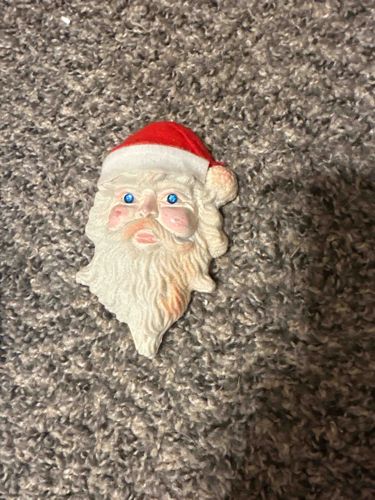
This item is a decorative representation of Santa Claus's head, likely functioning as a wall plaque, magnet, or a larger ornament piece. It is crafted from a molded material, possibly resin, plaster, or bisque ceramic, given its matte finish and tactile appearance. The dominant colors are white for Santa's beard and mustache, a skin-tone peach for his face, vibrant blue for his eyes, and a rich red for his cap, which appears to be made of a textured felt or velvet material, possibly glued on. A white, fluffy trim resembling faux fur or cotton batting adorns the base of the red cap and forms a pom-pom at the tip. Santa's facial features are distinctly sculpted, with rosy cheeks, a red nose, and a slight smile. The beard and mustache show molded texture to mimic hair strands. There is a noticeable orange-brown discoloration or stain on the lower right side of Santa's white beard/neck area, indicating wear, age, or a manufacturing imperfection. The overall style suggests a vintage aesthetic, possibly from the mid to late 20th century. The craftsmanship is decent, with hand-painted details, though the application of the blue paint in the eyes seems a little uneven. The back of the item is not visible, so its hanging mechanism or flat backing cannot be determined. The edges are clearly defined, indicating a casting process. Its size appears to be relatively small, perhaps 3-5 inches in height, suitable for decorative display.
AI Appraisal Report
Based on my visual examination of the provided image, this Vintage Santa Claus Wall Plaque or Ornament appears to be a charming piece of holiday decor. It is likely crafted from a molded material such as resin, plaster, or bisque ceramic, with hand-painted details. The red cap, possibly felt or velvet, with its faux fur trim and pom-pom, adds a tactile element. The style suggests a mid to late 20th-century vintage aesthetic. The condition is fair, primarily due to the noticeable orange-brown discoloration on the lower right side of Santa's beard. This stain, along with the slightly uneven application of blue paint in the eyes, indicates typical wear and manufacturing imperfections common for mass-produced decorative items of this era. Given its likely small size (3-5 inches), it would have functioned as a wall plaque, magnet, or larger ornament.
In terms of market conditions, vintage mass-produced holiday decor like this generally has a modest demand. While Santa Claus items are popular, this specific piece doesn't exhibit exceptional rarity, unique craftsmanship, or a discernible maker's mark that would elevate its value significantly. Comparables in the market for similar molded Santa figurines or plaques from the mid to late 20th century, especially those with minor imperfections, typically retail in the $10-$40 range. The discoloration on the beard significantly impacts its appeal to collectors seeking pristine examples, thus keeping the value modest.
Limitations in authenticity verification are inherent when appraising from images alone. Without physical inspection, I cannot definitively confirm the exact material (resin, plaster, ceramic) or rule out any repairs obscured by the angle. An in-person examination would also allow for a more precise assessment of its weight, texture, and the adhesion of the cap material, as well as checking for any hidden marks or labels on the reverse side. Provenance documentation, if available, could provide historical context, but it's unlikely for common decorative items like this. No scientific testing is typically warranted for such pieces.