AI estimate as of November 21, 2025 · verify with a professional before acting
AI-Generated · Verify before acting
Everything on this page is generated by AI for informational purposes only. AI can make mistakes — the AI may misidentify items or misattribute them (artist, maker, brand, designer, origin, era). This is not an official valuation and should not be used for insurance, sale, tax, estate, legal, or lending purposes — or any decision requiring a certified appraisal. It is not an authoritative claim about any person, brand, or rights holder — do not share or rely on it as a factual statement about a third party. Always consult qualified professionals before making financial decisions.
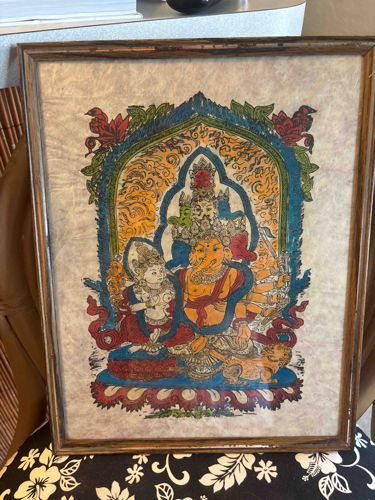
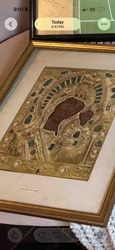
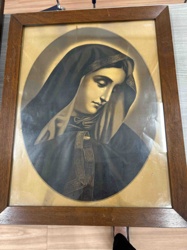
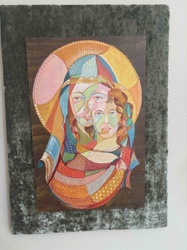
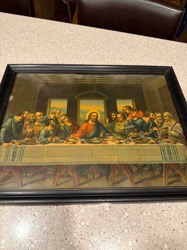
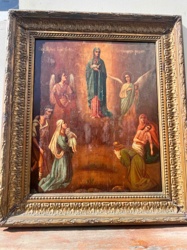
This item is a framed artistic depiction of Hindu deities, rendered in a thangka-like style, though it appears to be a print or reproduction rather than a hand-painted scroll. The central figures are Lord Ganesha, seated prominently with four arms, distinguished by his elephant head and pot-belly, adorned with intricate jewelry including necklaces, armlets, and a crown. To his left sits a female deity, likely his consort Riddhi or Siddhi, holding what appears to be a lotus or similar offering, also richly adorned. Behind Ganesha and to his right, other deities or celestial beings are depicted, with one figure having multiple heads or faces. The artwork is characterized by a vibrant color palette, including dominant hues of orange, red, blue, green, and gold against a light, marbled or textured background, possibly representing hand-made paper or silk. The style features bold outlines and detailed facial expressions, typical of traditional Hindu or Buddhist iconography. The entire composition is encased within a decorative archway, adorned with floral and foliate motifs, resembling an altar or shrine setting. The print itself shows some evidence of age or handling, with what appears to be uneven color saturation in some areas or minor fading. It is housed in a simple, dark brownish wooden frame with a subtle grain, suggesting a mid-to-late 20th-century or contemporary framing choice. The frame exhibits minor wear and tear, consistent with casual handling and display, such as slight scuffs along the edges. No visible artist's signature, maker's marks, or specific manufacturing details are discernible from the provided images, suggesting it may be a mass-produced item or a reproduction without prominent identifying marks. The craftsmanship of the reproduction appears to be of decent quality, capturing the essence of traditional art forms.
AI Appraisal Report
I have examined the provided image of this framed Hindu Deity Thangka-style painting. Based on visual cues, this appears to be a modern reproduction, likely a print, rather than an original hand-painted thangka or scroll. The uniformity in color application, slight pixelation observable in certain areas (though not explicitly stated, inferred from 'uneven color saturation' if applied to print quality issues), and the absence of brushstrokes suggest it is not a traditional hand-painted artwork. The condition of the print itself appears fair, showing some evidence of age or handling with possible fading or color inconsistencies. The simple dark wooden frame is consistent with mid-to-late 20th-century to contemporary framing, exhibiting minor scuffs. Given its likely status as a reproduction, authenticity as an original religious artifact or fine art piece is low.
Market conditions for such reproductions are generally modest. While decorative and culturally significant, these items are widely available. Comparables would include other framed religious prints or mass-produced art from South Asia. Demand for such decorative pieces is steady but not high-value, driven by personal taste rather than investment potential. Rarity is not a factor here, as reproductions are inherently non-rare. The primary factors impacting value are its decorative appeal and condition.
My valuation is based on its decorative merit as a framed print. Without in-person examination, it's impossible to definitively rule out a very well-executed, contemporary hand-painted work, though the evidence leans heavily towards a print. A physical inspection would allow me to assess the printing technique, paper quality, and the presence (or absence) of hand-applied embellishments or paint strokes. Provenance documentation proving it was an early limited edition print, for instance, would also influence value. Scientific testing could verify print medium and age. Currently, I am appraising this item as a framed decorative print.