AI estimate as of July 5, 2025 · verify with a professional before acting
AI-Generated · Verify before acting
Everything on this page is generated by AI for informational purposes only. AI can make mistakes — the AI may misidentify items or misattribute them (artist, maker, brand, designer, origin, era). This is not an official valuation and should not be used for insurance, sale, tax, estate, legal, or lending purposes — or any decision requiring a certified appraisal. It is not an authoritative claim about any person, brand, or rights holder — do not share or rely on it as a factual statement about a third party. Always consult qualified professionals before making financial decisions.
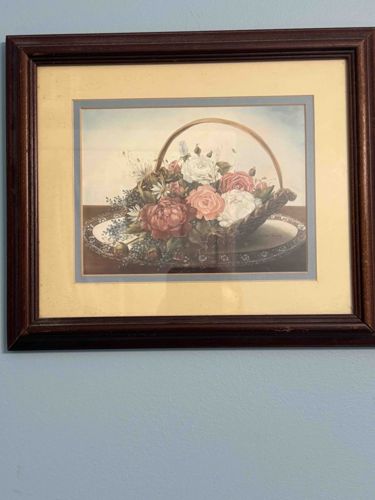
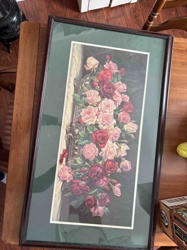
The item is a framed decorative print depicting a floral still life featuring a basket of various flowers resting on a decorative tray. The print is housed within a dark brown wooden frame with a classic, possibly ogee or rounded profile. The frame appears to be approximately 1.5 to 2 inches wide. The artwork itself is matted with a double mat. The inner mat is a subdued blueish-gray, creating a thin border around the central image, while the outer mat is a pale, creamy yellow or beige, which occupies a larger area between the print and the frame.
The central image showcases an arrangement of roses, peonies, and other smaller wildflowers in shades of pink, white, and red in a natural-colored woven basket. The basket, possibly a gathering basket or cornucopia, has a distinctive upright handle forming an arc above the flowers. The basket is placed on an ornamental silver or pewter-colored tray with intricate patterns along its rim. The background is subtle, suggesting a light, airy sky or plain wall, emphasizing the floral arrangement. No clear artist's signature or manufacturing marks are visible in the provided images. The overall style suggests a traditional or classical floral art period, likely from the late 20th or early 21st century.
Regarding condition, there are visible signs of wear on the wooden frame, particularly along the bottom edge, where small nicks or chips are apparent, exposing lighter wood underneath the dark finish. There also appears to be some discoloration or spotting on the lighter outer mat, especially noticeable in the top left corner. The print itself seems to be in good condition with no obvious tears or creases, although detailed inspection for fading or subtle damage is not possible from the images. The glass covering the print is clear, and there are no visible issues with it. The craftsmanship appears to be standard for mass-produced framed art.
AI Appraisal Report
Upon my virtual examination of this Framed Floral Still Life Print: Basket of Flowers, I've assessed its condition and potential market value. The print itself appears to be in good condition, depicting a traditional floral arrangement with roses and peonies in a woven basket on a decorative tray. The double matting, with an inner blueish-gray and outer creamy yellow, complements the artwork. However, the dark brown wooden frame shows visible wear, including nicks and chips along the bottom edge. More significantly, the lighter outer mat exhibits discoloration and spotting, particularly in the top left corner, which detracts notably from the overall presentation.
From a market perspective, this piece falls into the category of mass-produced decorative wall art, common in the late 20th to early 21st century. While attractive, such prints typically lack the unique artistic merit or rarity that would command high values. Comparables for similar decorative floral prints of this nature, even framed, generally range from lower-end retail prices, especially considering the condition issues. Demand for traditional floral still-life prints remains consistent but not elevated, particularly for unsigned, mass-produced examples.
Factors significantly impacting value are primarily the condition issues of the frame and mat. The wear and discoloration indicate a need for potential restoration or re-framing to improve its aesthetic appeal, which adds to the cost for a potential buyer. The lack of an artist's signature or any manufacturing marks limits its authenticity verification and establishes it as a decorative, rather than fine art, piece.
Limitations in authentication are significant with image-based appraisal. Without physical inspection, I cannot ascertain the print's exact printing method (e.g., lithograph, giclée), confirm if it’s an original or reproduction, or thoroughly assess for subtle fading, paper degradation, or concealed damage. In-person examination would be crucial to determine the exact nature of the print, the presence of any hidden markings, and to precisely evaluate the extent of discoloration and frame damage. Provenance documentation, if available, would be essential to trace its history and confirm any artist attribution, if one were claimed. Scientific testing would not typically be warranted for this type of item given its likely mass-produced nature.